Vinh Giang is a motivational/ inspirational keynote speaker. Along his journey as an Entrepreneur he has learnt so many lessons that have dramatically changed his life and business.
He has built a successful online business that teaches magic to over 41,000 students from all over the world, this business of his also won South Australian young entrepreneur of the year in 2013.
In this episode, we discuss:
The power of a personal brand for dentists
Escaping comparisons in a digital age
How to stop looking for a magic bullet
How to wow your patients by learning how to be a performer
Vinh’s five tips for using your voice like a performer to craft better patient experiences
As a perennial student of business, for many years I’ve studied success principles I think will help me do business better.
I’ve read thousands of books, spoken with hundreds of business owners, and had a few experiences myself. Through all this, one thing seems clear.
We can learn and apply timeless success principles to create a great business.
As the busy end of year looms, and planning moves into the frame, let’s do a quick refresh.
That way, we can round out the year end in great shape.
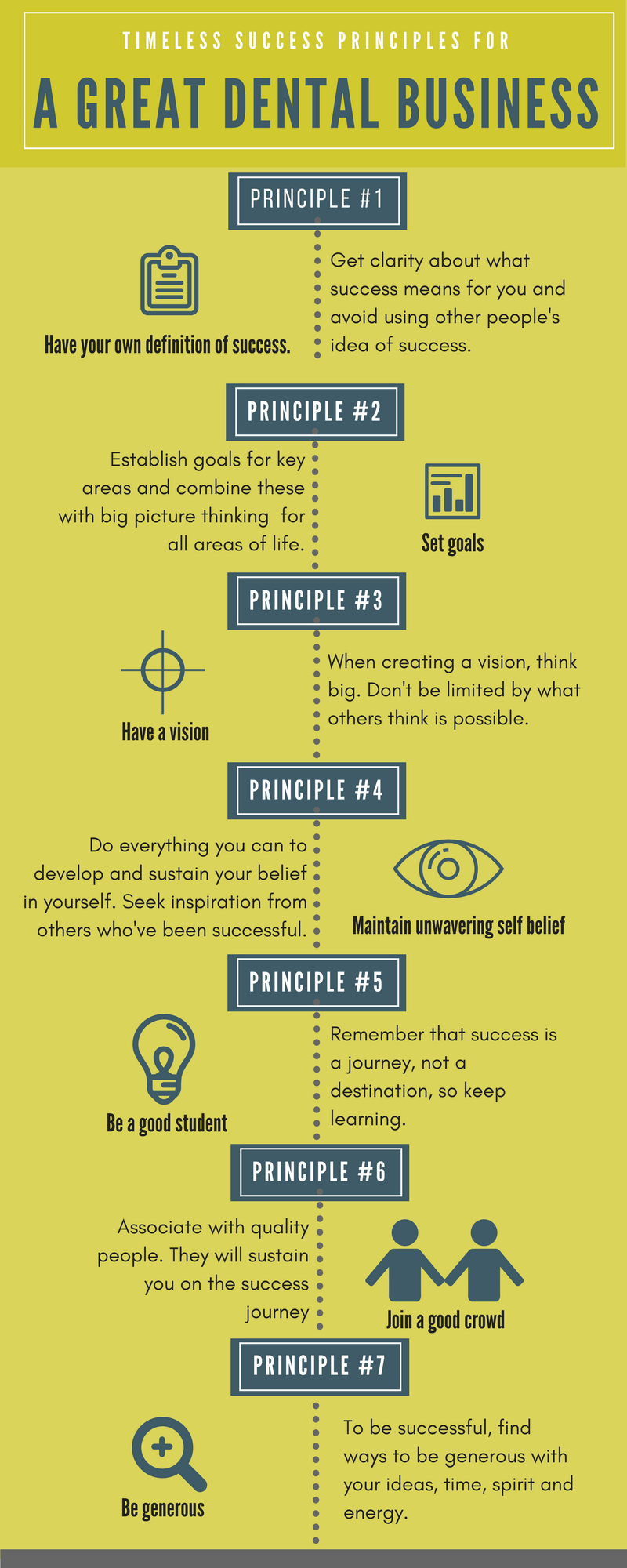
#1 Principle – Have Your Own Definition of Success
Success means different things to each of us.
You could say there are as many versions of success as there are people on the planet.
The challenge is, sticking with our version.
In a world where technology is everywhere, we’re easily caught up in somebody else’s definition of success.
Without a clear focus, we can be forgiven for thinking we’re being left behind.
The best way to overcome this kind of thinking?
Get crystal clear about what success looks like for you.
It could be financial freedom. Maybe it’s providing for your family. It could be contributing to your community or flying to the moon.
The bottom line is: design your success according to your definition.
Do that by investing time and energy to gain clarity about what success looks like for you.
Ultimately, this will drive you forward and keep you from being distracted by what others do.
#2 Principle – Set Goals
My coaching clients know I’m a big advocate of goal setting.
Working like a homing device, goals help focus attention, energy and effort. Just like defining your own terms of success, deciding your goals is personal too.
As business owners, we set goals for our practice – revenue targets, patient retention, patients booked. Business-oriented goals are great. They keep us effective in that realm of life.
But we’re multi-dimensional, so it pays to have goals in other areas like health and family.
You might do this by creating a single list or a list for each area.
Just be aware that multiple lists of goals can reduce effectiveness, rather than enhance it.
To overcome ‘the dilution effect’, I use the idea of themes I picked up from Andrew Griffiths, Australia’s number one business book author.
Themes are great. They’re general rather than specific and give context to goals. They allow you to see business and life from a ‘big picture’ perspective.
For example, I might create a theme to reduce distractions and improve productivity.
In that context, I might set goals to check emails twice daily and turn off notifications.
I may not monitor progress against these goals every day. However, at the end of several months or year, I’ll reflect and assess how I’m going.
Depending on progress, I’ll adjust my approach accordingly.
Goals set this way allow disciplined healthy habits to form. And habits are a well-known foundation of success.
Robert Collier was right when he said: success is the sum of small efforts – repeated day in and day out.
While themes create a picture of success; habits fill the picture in.
#3 Principle – Have a Vision
No business success if possible without a dream or vision.
Think about it. Your dental business wouldn’t be where it is now if you hadn’t created a vision and given it life by implementing a plan.
I love Andrew Griffith’s story about how he wrote his first book.
When he shared his idea with some so-called marketing gurus, they told him he couldn’t do it.
What they underestimated was Andrew’s vision to write.
He didn’t listen to them and that first book (along with eleven others) became a bestseller.
Create a vision and work towards it with a plan that’s supported by goals.
#4 Principle – Maintain Unwavering Self Belief
Even the most mentally robust among us have moments of doubt.
Yes, we’re human, but success relies on rock solid belief in yourself.
Without doubt, challenges will always arise in business and life. What I’ve found is it’s how we respond to the challenges, rather than the challenges that make us.
As far as possible load up your self belief by any means possible.
I find stories about people overcoming adversity keep me inspired. These stories show me that other people have faced challenges – and overcome them too.
It’s also vital to have people in your life who believe in you. This might be a business coach or mentor. It could also be a professional peer group.
Self belief is like a muscle. Ironically, just like resilience, it grows during challenging times.
Have clear goals and a ‘Why’ and your self belief muscle will have the best chance of surviving the stress test.
#5 Principle – Be a Good Student
What I’ve come to realise is success is not an end point.
Although it may be clichéd, success is a journey.
What this means is learning is never done if you want to be successful.
You only need look to some of the world’s most successful business people and you’ll see they have an ongoing commitment to learning and growing.
Whether it’s through books, courses or chance meetings, there is always something to be learned and gained.
Approaching life and business this way means we’re able to bring different new ideas and energy to what we’re doing, without having to reinvent the wheel.
Keep learning and you’ll be rewarded lifelong.
#6 Principle – Join a Good Crowd
It was the great success legend Jim Rohn who said:
“Don’t join an easy crowd; you won’t grow. Go where the expectations and the demands to perform are high.”
Success requires that we spend time with quality people.
It is their influence, character, energy and ideas that are infectious and call us higher.
One of the reasons I enjoy the business owners who make up the Practice Max community is their collective commitment to doing better.
They, together with other entrepreneurial communities I’m involved in, are an inspiration.
Apart from learning more, I’m motivated and energised purely through association.
Make sure your “people” are a good crowd and you’ll be sustained on your pathway to success.
#7 Principle – Be Generous
Being generous might seem out of place among success principles, but it definitely belongs there.
Truly successful people are generous: with time, ideas, spirit and knowledge.
In some cases, these people might be financially generous too, but it’s not the determining factor when it comes to success.
At its most basic level, successful people want to help others and solve problems.
Generosity can be delivered in many forms and like the definition of success, it’s vital you find one that works for you.
Some final words…
Success is really about understanding yourself better.
It starts by defining your own version of success, developing a plan, and going after it with an unwavering belief in yourself backed by some clear goals.
When we can do that, the rest kind of falls into place.
Andrew Griffiths is Australia’s #1 small business author with 12 books now sold in over 60 countries. He’s a writing and publishing expert, an international speaker and leading business advisor with over 20 years’ experience. Andrew presents around the world, sharing his ideas and expertise on all aspects of entrepreneurialism.
Considered an expert in entrepreneurship and an authority on building a profile as a thought leader through writing, publishing and speaking, Andrew is featured regularly in mainstream media globally. Andrew’s greatest strength is his ability to energise entrepreneurs to achieve extraordinary results.
His best selling books include: The Big Book of Small Business, The Me Myth, Bulletproof Your Business NOW, 101 Secrets to Building a Winning Business, 101 Ways to Sell More of Anything to Anyone, 101 Ways to Market Your Business and more.
In this episode we talk about:
The challenges of doing business and the secret to achieving great success
The importance of being a peak performer to be successful
How to focus on one thing at a time, and why you should
How listening more and talking less benefits your business
The importance of simplification to getting things done well
The things successful people do differently
The top extraordinary, successful and inspirational people for Andrew Griffiths
Making mistakes, get it right and learning along the way
Finding success in our own terms
The importance of developing good work habits
The illusion of productivity
Personal success vs business success
Getting what we think we want
How becoming clear on what we want in life gives us extraordinary clarity of what success truly means
Innovation can be applied to dental practice in many ways. However, we often overlook it as the means to enhance business value directly.
In the world of dentistry, we typically associate innovation with development in a technology or treatment technique.
Looking at innovation this way creates a perception that the power for innovation is in the hands of someone else, i.e. external to the practice.
But could we be missing the point of innovation?
I feel we could be.
As business owners, we often have our faces pressed up hard against the window of our practice.
That proximity – or closer perspective – means we could overlook opportunities to innovate.
It could also mean we discount the value of innovations we’re already making within the practice.
Taking a step or two back, can create a wider vision that reveals innovation possibilities you never considered.
What is innovation?
Innovation is defined as the introduction of new things or methods.
Businessdictionary.com defines it as:
“an idea that must be replicable at an economical cost and satisfy a specific need. [innovation] involves deliberate application of information, imagination and initiative. In business, innovation often results when ideas are applied to further satisfy the needs and expectations of customers.”
I don’t know about you, but I think this is good stuff to know.
Innovating in our practice is important. Even more so now with disruption caused by factors outside our industry, much of which is beyond our control.
In the face of change, what we do have control over is our response to these factors. And this is where an openness to innovation can pay dividends.
How do you bring innovation to a dental practice?
As humans, we’re inclined to stick to the familiar.
Deviating to what’s different? Not so much.
Even if we know different is good for our business or others – for example, our patients – there’s a possibility we might resist change arising out of innovation.
Getting around that resistance is easier than you think. And chances are, you’re already doing it.
Putting aside the innovations in technology and treatment techniques, there are simple ways to innovate within your dental practice.
Don’t aim for perfect. Strive for prolific instead.
When you’re looking to get things done in your business, perfectionist tendencies can hold up progress (although they’re wonderful in a treating dentist).
In innovation terms, this means ‘having a go’, rather than waiting for perfectly right.
In practical dental business terms, it could mean different things.
It could mean putting together that email marketing campaign to connect with new patients, even if you don’t know how it will be received.
Or implementing that new standard operating procedure, even if you’re not one hundred percent clear on every step.
It could even mean introducing a new service that provides a more integrated level of care to patients. Even if you’re not sure of what the uptake will be.
My coaching clients have heard me say “prolific beats perfect” many times.
It’s a mantra I live by.
While action must be underpinned by strategy, it’s through the process of doing, we discover ways to innovate.
Look outside dentistry. Swipe and deploy.
As counter-intuitive as it feels, looking outside dentistry can be a good place to discover new ways of doing things that could work in your dental practice.
It’s why another maxim I live by is ‘swipe and deploy’.
Swipe and deploy means you take what others do well and apply it in your own business.
That’s how I came to focus on marketing in dentistry.
Apart from my own interest in marketing, studying what others do means I see what could be relevant for me.
Very often, it is through this act of bringing outside thinking to your practice that innovation occurs.
Katherine is owner of Brisbane Natural Health, a clinic providing naturopathy and other alternative treatment modalities to patients.
What’s different about her approach is she uses a membership model.
Packaging up treatments and having patients pay for them under a recurring membership model is an innovation in that industry. However, many industries have used this model successfully.
The model wasn’t perfect from day one, however by making this step change, Katherine and her team took a big leap forward. They also added value to her business.
Now they continue making evolutionary innovations, refining what they do to deliver the highest level of quality patient care.
Undoubtedly, it took time, persistence and a few hiccups along the way. That’s what innovation looks like.
Borne out of the desire to do things better, innovation can be the game changer, adding tangible value to your business.
Look at what’s in front of you. Do that better.
It might sound like I’m stating the obvious, but humans have a knack of overlooking what’s right in front of them.
Innovation in your dental practice simply means you look for what can be done better now.
Chances are, you’re sitting on a trove of innovation treasure. And it doesn’t all reside with you as the practice owner.
Often our team have within them the seeds of innovative ideas.
Working on the ground and in the practice, your team is perfectly positioned to innovate.
I know as a graduate dentist, I was full of ideas. I like to think I still am.
While some of my ideas may not have been world-beating, as an employee, I was still thinking about how things could be done better.
If you have even one team member who has ideas, be prepared to listen – and act.
In that person, you may discover the seeds of innovation that can add value to your business.
And some final thoughts…
Change in our industry calls us to think out of the box and find new and different ways of doing things.
Innovation that creates value in business doesn’t need big changes.
The seeds of innovation can be found both inside and outside your business. Look for them.
Incremental improvements – even one percent better – will show up as value. For you, your patients and your business. Do one percent consistently and it starts to add up.
Katherine Maslen is a naturopath, nutritionist, author and renegador for health. She founded Brisbane Natural Health – a wellness centre where they work as a team to get overcome their clients health issues. Brisbane Natural Health are Australia’s first and only membership based wellness centre.
After completing 2 bachelor degrees in health science, Katherine has been helping people to be their best through health for over 9 years. She has spent most of this time one on one in clinical practice – in the trenches with her clients to navigate them through the minefield that is imperfect health.
In this episode we chat about:
How to survive the tough periods in your business
Why prolific beats perfect
How a membership model works in a clinical setting
Growing a dental practice can test a dentist’s patience.
We have a vision. We know what needs to happen next. Why can’t we be there already?
But here’s what I’ve found: steady, consistent action applying strategies that work is what yields the best results.
Deceptively simple, some strategies can be overlooked.
However, on deeper consideration and implemented well, they have the power send your dental practice into business overdrive.
Want to move from dentist to business owner faster?
Let’s look at three hot tips for making that happen.
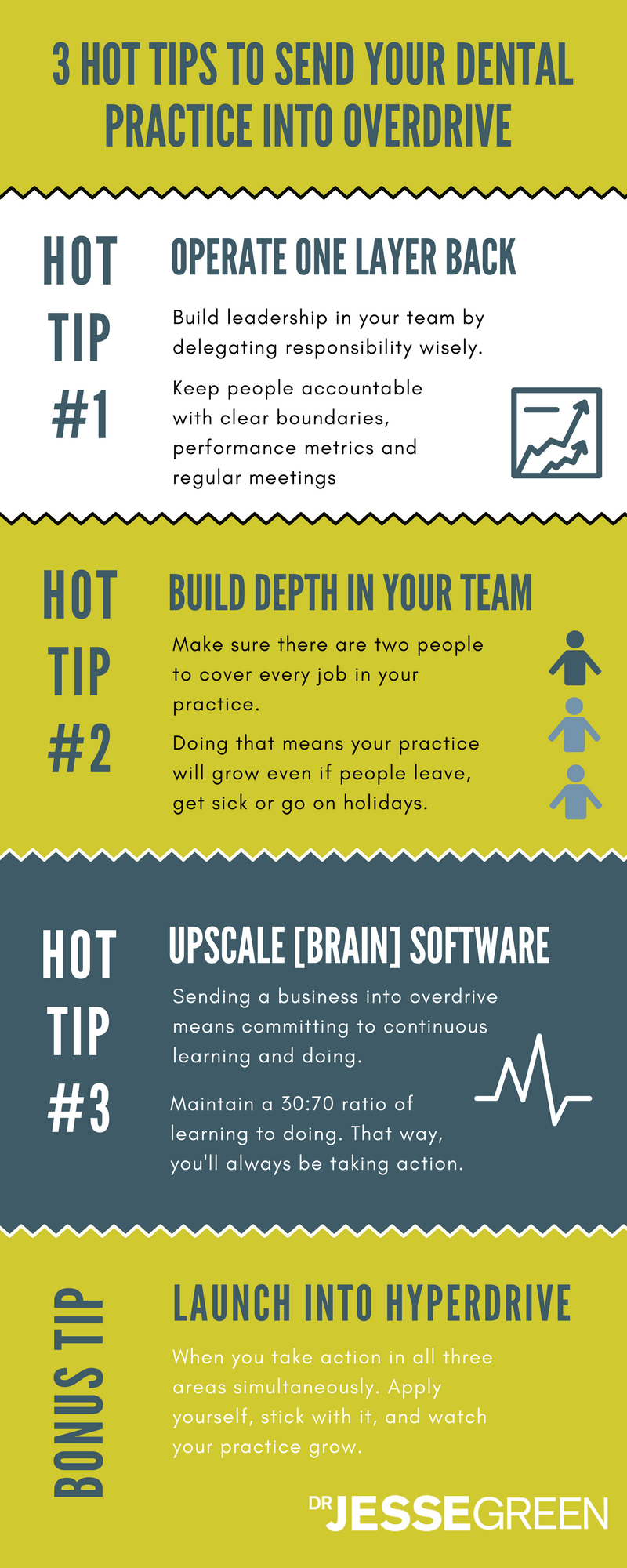
Hot Tip #1 – Operate One Layer Back
A technique for accelerating business growth that I learned from my friend James Schramko is: operate one layer back.
What does that mean?
A traditional dental practice relied almost completely on the actions, effort and work of a single person: the dentist.
Notice I said traditional?
Contemporary practice of dentistry – at least if you want to transcend the owner/operator model – affords you no such luxury.
Instead, it requires that you move towards operating one layer back from the decision-making in your practice.
And no, it’s not an invitation to delegate all decision making.
Rather, operating one layer back means you’ve identified those decisions you can sensibly transfer to a trained and competent team member. In doing so, you free yourself up to do other more meaningful work that will grow your business.
Operating one layer back also means you’ll have appropriate checks and balances in place for accountability.
You can do this via regular meetings, performance measurement against key metrics and clear operating boundaries.
Operating one layer back is an essential step towards building leadership beyond you in your dental business.
What this means is you, as the leader, are no longer the bottleneck. In fact, if executed well, the bottleneck will have disappeared.
There are many benefits to operating one layer back, but the biggest is the opportunity it provides for business growth.
Hot Tip #2 – Build Depth In Your Team
In parallel to operating one layer back, it is wise to build depth in your team.
Building depth is not about hiring more people. No, it’s about more people knowing how to do more in your business. Think Noah’s ark and having two of everything.
That way, if someone gets sick, leaves or takes a holiday, your dental practice continues to grow and thrive regardless.
The best starting point for building depth is to review your organisational structure – as it is now and ‘the ideal’.
It also helps to review your current team and assess where the latent capacity and capability lies.
Is there a team member who shows initiative? Has someone shown an interest in helping out with tasks beyond their role?
If they have, consider how they might help you build depth in your team.
Underpinned by clear boundaries, performance metrics and accountabilities, building depth in your dental practice is another way to send your business into overdrive.
Hot Tip #3 – Upscale Your (Brain) Software
In a technology driven world, we’re regularly reminded about software updates for our various programs and apps.
When the little reminder comes up, we press ‘Update Now’ and move on.
If only updating our own software (i.e. our thinking) was that easy.
An essential for any owner/operator wanting to make the step change to business owner, updating our software through learning and development is a must.
Learning can take many forms – seminars, books, podcasts, online content, connection with like-minded others.
It really doesn’t matter what the source is. What’s more important is that you are learning and applying what you’ve learned.
Study like this is as pivotal to your dental business’ success as those compulsory professional development hours you rack up each year.
And remember, it’s not simply enough to learn for the sake of learning.
The rubber really hits the road when we apply what we’ve learned.
Generally, I recommend to my coaching clients to work to a 30:70 ratio when it comes to learning and application.
Too much learning, and we can become paralysed. Not enough learning, and there’s no growth.
I hold firm to the view the growth of a business will never outstrip the growth of the business’ leader.
This is incentive enough for me to keep learning – and applying what I’ve learned – to ensure my business continues to thrive.
What’s The Take-Away?
What’s the take-away here for you?
Yes, there are the three hot tips for putting your dental business into overdrive – operate one layer back, build depth in your team and upgrade your software.
But there is one other take-away here – and I don’t want you to miss it.
Taking action on any one of these fronts will make a difference to your dental business.
However, taking action in all three areas really will boost your business into overdrive.
Apply yourself, stick with it and watch things grow.
In this episode, Dr Jesse Green shares his 3 top tips for putting your practice growth into hyperdrive. If you want to transcend the traditional model of owner-operator (as is common for dental practice owners) and step into true business ownership, this episode it for you.
In this episode Dr Jesse Green discusses:
Quick tips for building up a leadership team
How to ease the pressure on yourself to do everything
How to structure your team for success
What limits the growth of practices and how you can overcome it
While the dentist in me loves perfection in patient care, the entrepreneur in me gets a kick from creating business systems for our practice.
I love this stuff because it creates order and structure.
My opinion? Order precedes forward movement.
Order is achieved by bringing structure to business. It follows that structure comes through development of frameworks and processes that support the business to grow.
I’m not talking about business systems for the sake of systems, like the kind you hear about in corporate behemoths. You know, the ones that create layers of overbearing bureaucracy.
No, the kind of systems I’m referring to are the ones that make sense and work.
Developed and implemented by the people that use them, systems – comprised of frameworks and processes – create freedom.
Ironically, systems don’t constrain business.
Instead, it’s the discipline and consistency created by systems that makes life easier. This is true for people who use the systems – and the business they support.
They also lead to the creation of value, as systems become measurable, tangible assets.
But it’s vital to remember there’s no one size fits all, so let’s look at how systems can work for dental practice owners.
Tailor the system to suit your dental practice
When Ray Kroc franchised McDonald’s, he knew systems would be the making of the business model.
Although the Golden Arches’ level of systemisation and sameness is just fine for burger and fries’ production, it’s not necessary – or appropriate – for a dental practice.
With people’s health and wellbeing our primary concern, the nuances of individualised patient care require more than just systems.
In addition to a robust formula for treatment delivery, a healthy dose of emotional intelligence is also required to achieve a beautiful balance in patient care.
Achieving this balance is no easy feat, but when it works well, you witness the way a dental practice shifts gears and starts to rock.
The way to strike the balance is tailoring the system to suit the business’ needs.
This means neither under, nor overdoing, the system.
When I started putting this into practice in my own business, I worked out a simple formula.
Task-based processes need a standard operating procedure – or SOP.
Activities requiring ‘personality’ could be documented using a framework.
Need to know more?
No problem. Let’s explore these system ideas further.
Understanding SOPs
A standard operating procedure functions like a checklist. You could also think of SOPs as the ‘habits’ that make your business work.
Outlining each step for getting a job done, an SOP provides a task description and the relevance of the task. It also clarifies who has responsibility for the task.
When you think of SOPs think tasks like ensuring lab work leaves the practice correctly, instrument sterilisation and treatment room set up.
For these jobs, there’s one right way of doing things. Documenting it, means there is greater consistency and less confusion (as well as fewer arguments about who’s way is the right way).
Is it hard to prepare SOPs?
Well, it doesn’t have to be.
In our practice, we work on the premise of creating ‘speedy’ SOPs. You can download this template to get you started.
With the goal being to write up the steps of a task in three minutes or less, this approach helps remove the overwhelm associated with documentation.
Naturally, there’s a testing and review process that follows.
What you’ll find is however, this review flows more easily once the initial SOP is created; especially when the job owner writes the SOP.
Formulating frameworks
Different to an SOP, a framework is suitable for any task involving human interaction.
Think the new patient phone call, the complaint handling conversation or request for a referral.
A framework is like a guide.
Unlike an SOP, it doesn’t state “this is exactly what you do”. Instead, it says, ‘here’s the outline; use it to navigate your way.”
Flexible and stable, a framework is a platform from which your team can tailor their approach, according to what’s in front of them.
And while a framework might take team members a little time and practice to get used to, in the long run, I feel frameworks are infinitely superior to rigid scripts that can tie a person down.
Putting systems in place
When implementing a new system, there are a few things to keep in mind:
#1 Work on one system at a time. Choose one, nail it, then move on to the next one.
#2 Have a plan. Use your existing system (even if that system isn’t formal) as the start point for deciding what your system needs. Develop your plan from that, including any obstacles you’ll need to overcome.
#3 Implement. This is about getting it done, so work to the mantra ‘prolific beats perfect’. Allow four to six weeks to integrate any new system.
#4 Have a positive feedback loop. To keep your team engaged, give positive feedback on a job well done. Make it fun and celebrate wins.
#5 Report back regularly. Use your weekly staff meeting to keep the team posted on progress on system implementation. This is especially important if they’re contributing to development of SOPs and frameworks.
#6 Test, adjust, iterate. Take time to test new systems and adjust the approach accordingly. Once in place, systems will always need updating. An iterative process, improvements to systems will be ongoing.
A final word…
So there it is. A quick and simple wrap up on business systems for dentists.
Developing practice systems is a wonderful vehicle for creating ownership in your team.
It’s one of the best ways to create value in your business – outside of yourself.
And, it’s the fastest road to freeing you up to focus on more ways you can grow and scale your practice.
In this episode, Dr Jesse Green shares his approach to systems that are both supportive enough to make your practice run more efficiently, but flexible enough to help you deliver personalised patient care.
You’re running a dental practice, but did you know you’re really the owner of a dental business?
It’s a question being posed to more and more dentists.
And most of my readers will know why.
It’s no secret things have changed in the world of dentistry over the past five years.
A topic covered extensively in my book, Retention, and in previous blogs, if you’re reading this, chances are, you’re familiar with the changes – and associated challenges.
The bottom line for we dentists is: the concept we had of dental practice when we graduated has evolved.
Whether it’s through willing acceptance or a grudging denial, the reality is dental practice is really about being in the dental business.
Here’s how you know if you’re operating a dental business.
You accept your business (world/technology/everything) is changing
There’s a wonderful cliché that says you have only two guarantees in life – taxes and death.
I disagree, maybe because I’m more of an optimist.
To the list of guarantees I’d add one other thing. Change.
Ask any entrepreneur who’s ‘made it’ and they’ll tell you, managing change has been part of their road to success.
Change in business and life is inevitable. Fact.
While we might think change is a problem or challenge for us, usually it’s our perception of change that’s the issue.
Time for a reframe?
In the highly dynamic world in which we live, change seems faster and more frequent. Sometimes, even the most agile among us can feel things move too quickly.
Change is evident across our industry – in technology, patient expectations and business management practices.
So how do we manage and keep up with the pace of change?
“The only thing that you can control is yourself….so coming to a point where accepting that change is going to be a constant is just a fact…of business life.”
I couldn’t agree more.
Accept change is part of life – and your business – and you’re already a big part of the way there.
But it’s not easy. After all, it’s human nature to seek the road most familiar and frequently travelled.
Acceptance comes when we let go of thinking we can control everything, and just focus on controlling ourselves.
Focus on mastering this, then watch your change management muscle strengthen.
You’re solving a problem
Yes, you trained to be a dentist, but did you know you’re also a business owner solving a problem?
If you’re in dental practice today, that’s what you’re doing for patients.
Whether it’s maintenance, a recall or something more complex, the problem our patients want solved is “how can they be healthier and feel good about themselves?”.
Not only is the unique way you solve this problem a wonderful form of marketing, technically, it is also your ticket to entrepreneurship.
Once considered a criticism in dental circles, the idea of the dental entrepreneur is gaining traction.
My opinion?
The true essence of an entrepreneur is someone who adds more value than they take.
They’re also able to adapt to change and be flexible.
By sheer virtue of the fact you’re operating in a competitive and dynamic market and solving problems means you’re in operating a dental business.
Keep listening to your patients (customers) and you’ll keep finding problems to solve.
You know marketing is a business function, not a luxury
One of the core functions of any business is being able to attract and retain customers – or patients. This is where marketing plays an important role.
But for a dental practice to scale and grow and evolve to a dental business, it’s no longer enough to simply hang your shingle on the door.
Somewhere between increased competition and a shift in market conditions, things changed for dentists.
More than just a one-off recall letter or reminder SMS, dental business marketing now involves multiple forms of communication.
Think many touchpoints via snail mail, email, telephone, in-chair, advertising, social media, and on it goes.
You know you’re in a dental business when you start taking the ‘marketing thing’ seriously.
Ever-changing, implementing a marketing plan that works takes a commitment to keep learning. It also requires a willingness to step outside our comfort zone.
Which brings me to another clear pointer you’re operating a dental business: growth and learning.
You’re hungry for growth – yours and your dental business’
Another sure sign you’re in a dental business is your innate desire to learn as much as you possibly can.
Not just about business, your learning could be in any area of life. It really doesn’t matter, just so long as it’s learning that leads to growth.
I recall reading somewhere that owning a business is the best personal development course around.
I’m inclined to agree.
It’s one of the toughest gigs going – hard work, long hours, and uphill battles on tough days – but the learning and growth that’s gained makes it totally worthwhile.
A final word
One of the great benefits I see for dentists embracing business ownership is their expanded awareness.
This is most apparent as they integrate strong technical knowledge and skills and patient care, with a growing repertoire of business, people and marketing management know-how.
A step change for most of us, I regard this as positive and necessary for our industry – and our dental businesses.