Deborah Morandin is the CEO of both Entrepreneurs Paradise and The Butterfly Experience. She has spent 20 years immersed in her passion for business and training, inspiring, mentoring, motivating and building businesses.

At The Butterfly Experience, she creates champions in media and helps small business owners scale to become entrepreneurs.

Deborah began her Butterfly empire in 2003, after recovering from a spinal accident. She hit the ground running with her signature program The Butterfly Experience where she went from zero to six figures in her first six months in business.

She also calls Richard Branson a friend. As part of Entrepreneurs Paradise, Deborah hosts events exclusively on Necker and Makepeace Island – the private islands of Richard Branson.

In this episode we chat about:

  • Why you need to set aside time for thinking each day and how it benefits your business
  • How to become more resilient
  • Deb’s friendship with Richard Branson (and how she did it!)
  • How to get into the media
  • Why you need to up your networking game

More about Deb Morandin

Entrepreneurs’ Paradise

The Butterfly Experience

Imagine this.

You discuss a problem issue with one of your team members, and they offer solutions.

You’re drowning in work and one of your team notice. And they offer to help.

You ask a team member if they can do something for you, and they’ve already taken care of it.

That’s the sort of team you want, right? The sort of team you can rely on – one you can’t live without.

But chances are it’s not the team you have.

How do I know?

Because most practice owners have too much to do, and too little time.

They have a team, but they struggle – at least a little – to create an amazing team. By elite, I mean one that moves like the proverbial well-oiled machine.

A group of people who anticipate your every move.

A group of people who actively support you, your patients and each other.

A team of conscientious, proactive people who don’t need a lot of direction.

I help a lot of practice owners develop leadership and delegation skills so that they can create an elite team like this.

But there are some people who struggle, despite having these skills.

And that’s because there’s a problem.

You see, some people learn all the leadership and delegation skills and they still can’t create an amazing team.

It’s not that there’s anything wrong with their team, or the training they receive.

And it’s not that they’re not ‘strong’ enough leaders or that they fail to give clear direction.

The problem goes deeper than that.

There’s a key difference between practice owners with a truly elite team and those that are struggling to get their staff to help them.

Most business owners ask themselves how they can get their team to help them.

But that’s not the question they should be asking.

Because business owners who have a team they can boast about ask themselves a different, much less obvious question.

And it changes everything.

The Single Most Important Question

So what’s the question?

Great business owners ask, “How can I get my team to want to help?” (Click to Tweet)

Teams are made up of more than just functions that need to be performed. They’re made up of human beings.

So to create a high performing team, your people need to do more than go through the motions.

And you need to do more than go through the motions of acknowledgement leadership and delegation.

You need to make sure your people feel valued. To make sure they understand that their contributions make a difference.

You need to build their confidence and demonstrate your appreciation for them.

You need to nurture the personal relationship you have with each and every person in your team.

Because we perform at our best when we feel good about ourselves. When we feel we’re doing a great job and making an impact in the world.

great biz owners

How To Create An Amazing Team

So how do you go about motivating your team – so they actively want to help you?

There are five key traits you need to demonstrate.

Sincerity

Always be sincere with your praise and acknowledgement.

You can smell insincerity a mile away, and so can your staff. So be sure the positive feedback you give them is genuine.

Remember that it’s not always about the outcome. Sometimes it’s about the effort. Acknowledging the hard work that an employee puts in will encourage them to try again, even if their first attempt was a failure.

As Thomas Edison said,

“I didn’t fail. I just found 2,000 ways not to make a lightbulb; I only needed to find one way to make it work.”

Specificity

Always be specific with your appreciation. “Great job” doesn’t cut it.

It doesn’t allow an employee to understand what they did well – and should repeat – or why their actions were effective.

Instead, try “I love the way you listened to confirm what Mrs Jones was saying today.” Using the following opening lines will get you into the habit of demonstrating sincere and specific appreciation:

  • “Thank you for …”
  • “I appreciate the way you …”
  • “I love the way you …”
Acknowledgement

Fostering initiative and innovation can be challenging, but it’s how you encourage people to be proactive.

It takes courage to offer up ideas for consideration. So when someone puts forward an idea be sure to acknowledge it, even if it’s not entirely viable. Because often brainstorming crazy options can lead to an innovative solution.

People are more likely to show initiative and think outside the square if they know their ideas and opinions are valued.

Demonstration

Demonstrate trust and confidence in your team member’s ability by asking for their ideas and opinions. (Click to Tweet)

When they seem challenged, resist the temptation to take over or solve a problem for them. Instead, use your coaching skills to empower them to resolve the challenges.

You Can Do This

So now you know the secret you can create that elite team you’ve always dreamed of.

The one that goes out of their way to support you and your patients.

The one that helps you with your problems, and anticipates your needs.

The one you need for business success without burnout.

All it takes is a little motivation, a little sincerity, and little acknowledgement.

As Dwight D Eisenhower said,

“Motivation is the art of getting people to do what you want them to do because they want to do it.”

So every time you start wondering, “How can I get my team to …” stop yourself.

And ask instead, “How can I get my team to want to help?”

Because that one question changes everything.

Even your business.

motivation

Dr Nauv Kashyap bought his first practice in 2008 with approximately $400K a year turnover and 2,500 patients. That practice has seen more than 20,000 patients and in 2015 will turnover approx. $2.5million. He has started a further ten dental practices and has also sold practices. He continues to find opportunities for successful startups and takeovers even through a saturated dental market.

The first Dental Practice Owners Conference will take place later this year after the huge success of the DPO (Dental Practice Owners) Facebook group started by Nauv in 2014.

We talk about:

  • Defining what success looks like for you and finding models outside of dentistry
  • Spotting opportunities
  • Why “irreplaceable” employees are not ideal
  • How to flick the switch from being owner-operator to true owner
  • Why you should consider attitudinal based hiring

Find out more about Nauv Kashyap:

Website: http://www.practiceownership.com.au/about/

Dental Practice Owners Conference: http://dpoc2017.com.au

Frustrating aren’t they?

Patient cancellations, I mean. You have a full day booked, but then out of the blue people cancel.

Or worse. They fail to turn up for appointments.

So your full day becomes full of holes.

And if you’re not careful, you’ll never see those patients again. That’s right, they might disappear forever.

So how can you stop this happening?

How can you prevent patient cancellations?

Is that even possible?

Well, it turns out it is possible. Not only possible but relatively simple too.

You see, this problem is usually preventable and is typically the fault of the practice – not the patients.

Cancellations and no-shows open up holes in your appointment book and represent lost income and opportunity. (Click to Tweet)

Years ago a mentor taught me that the purpose of an appointment is to book another appointment.

Clearly, creating a practice that has minimal time lost to these causes is critical for both patient flow and cash flow.

However, what is often overlooked is the importance of minimising cancellations and no-shows to aid patient retention. The loss of a patient is usually preceded by a cancellation or no show.

There are two main ways to prevent cancellations, and they are:

  • Building Value
  • Gaining Appointment Commitment

So, the key to preventing cancellations is to build value and to obtain appointment commitment for every appointment.

Cancellations1

How To Build Value

Here’s the thing that no one will tell you: The cancellation process did not start on the day of the scheduled appointment.

The cancellation process started at the time of the previous appointment or last contact with the practice.

The problem is that the dentist and other team members have not built value for the next appointment. The patient is constantly faced with competing priorities, so it’s easy for them to push off the dental appointment because they don’t realise that they are losing anything.

What should happen is that during the appointment and at the end of the appointment, the dentist must clearly explain why it is important that the patient return.

By elevating the priority of dental treatment in the mind of the patient, they are more likely to keep the appointment if there are conflicting priorities. Value for appointments is built before, during and after the appointment.

Obviously, some patients will cancel for perfectly legitimate and compelling reasons such as a death in the family or the patient wins an overseas trip (yes, this happens) or whatever. But your reception staff need to be able to determine what is reasonable and what is merely pushing the appointment off.

How To Gain Appointment Commitment

In his book, Influence – The Psychology of Persuasion, Robert Cialdini discusses six psychological principles that are involved in the ability to be influential. One of these is the principle of Commitment and Consistency.

Cialdini states, “Once we have made a choice or taken a stand, we will encounter personal and interpersonal pressures to behave consistently with that commitment.”

The premise of Cialdini’s argument is that when a declaration is made publicly, the person is far more likely adhere to it.

When a commitment is first sought by the practice and then given by the patient, the likelihood of a last-minute cancellation or no-show is greatly reduced.

How do you gain this commitment? Simply say something like this to the patient:

“OK Mrs Jones, we’re looking forward to seeing on Wednesday at 3.10 pm for your examination. So, you’ll be OK to keep that appointment?”

Note: If the appointment is being made in person, say this as you hand the appointment card over. Keep hold of the card until they make the commitment.

Cancellations2

What To Do If a Patient Cancels

Even with the best intentions, patients may still cancel, and knowing how to handle that is essential. If a patient does ring up to cancel, take the following steps:

1.      Establish If The Cancellation Is Avoidable

Motivate the patient to keep the appointment by referring to their “hot buttons”. I coach my clients to say something like this:

“Mrs. Jones, I see from your file that you’ve had some pain on the upper left-hand side. In order to avoid another episode like that Dr Green really needs to attend to the cavities on the right hand side. Is there any way you can make today’s appointment?”  [PAUSE]

2.      Make a New Appointment

If the cancellation is unavoidable, remake the appointment immediately and obtain a commitment from the patient to attend.

Rebook the appointment, but try not to be too readily available or the patient may feel you’re at their complete disposal. You do not want patients to treat you as a convenience rather than a trusted advisor.

When making the new appointment, be sure to gain appointment commitment.

If the patient declines to make another appointment immediately, then move on to obtaining permission to contact the patient to make another appointment, and ensure that the recall phone call is recorded in the practice management software.

3.      Handling Repeat Offenders

Where a patient repeatedly cancels, I recommend saying something like this:

“Mr. Smith, when you first came to our practice, I indicated that our philosophy is to be as comprehensive in our approach to dental treatment as possible. When you keep cancelling your appointment at short notice, I am not able to provide the level of care our patients have come to enjoy and expect. I really need you to attend the appointments that you schedule with our practice. Can you help me with that?”


Get Rid of Cancellations, Now

Not handling cancellations implicitly trains patients to believe that they’re acceptable. (Click to Tweet)

But they’re not acceptable. They impact your bottom line, cause disruption, and can lose you patients.

You don’t have to put up with that.

Instead, implement a simple process for handling cancellations elegantly and effectively.

Build value for your patients and gain their commitment to appointments.

When you do, you’ll see an immediate reduction in cancellations.

Your day will remain fully booked, and you’ll never have to wonder where your patients are disappearing to again!


Cancellations 3

Nathan Paris is the CEO of Dental Conversions. Nathan has over 20 years of international experience in systemising and automating processes through various technologies and methodologies. In 2012 he co-founded ON THE FUZE which specialises in sales and marketing automation for small businesses in Australia.

After seeing a huge need for automation in the dental industry, Nathan launched Dental Conversions in late 2015 focused on helping Dental Practices cut operations costs while also increase fees through automation.

Dental Conversions’ product Revive is a Virtual Treatment Coordinator that helps practices take advantage of the enormous value of their Incomplete Treatment List.

Nathan is from the Colorado, USA, and now lives with his wife and 3 children in Brisbane. He spends his spare time watching his kid’s play sport and enjoying craft beer…and if possible both at the same time!

In this episode, we chat about:

  • Where dentists go wrong with their systems
  • The true cost of not systemising and automating multiple modes of follow-up
  • How you can harness changing automation trends
  • Why automation still has to have a human element (and how to do that)
  • How to nail a follow-up email that gets read and acted upon

Find out more about Nathan Paris:

Website: www.dentalconversions.com

Twitter: @DentalConv 

LinkedIn: https://www.linkedin.com/in/dentalconversions

Payroll isn’t sexy, but it is necessary. (Click to Tweet).

It’s also critical to get it right because if you don’t, the consequences can be huge. Really.

You can receive fines of tens of thousands of dollars. And those fines are NOT tax deductible, as I discovered when I spoke to Tracy Angwin recently.

Tracy is the driving force behind the Australian Payroll Association and the bestselling author of ‘The Payroll Revolution’ and ‘Profit from Payroll’.

Tracy shared some fantastic strategies on how to avoid overpaying staff, how to ensure your staff leave balances are correct, and some small business horror stories.

If you haven’t listened to the podcast yet, I’d highly recommend it. It’s filled with expert advice on common mistakes made by small business owners.

Talking to Tracy got me thinking about other mistakes that small businesses frequently make with their payroll.

Tracy and I couldn’t cover everything in the podcast, so I did a little research. I found there are several mistakes that we didn’t get time to touch on and I wanted to share those with you here.

I’m not an expert in this area, so I’m sharing advice from other specialists in the field.

At the end of the day, this is a very complex area. It’s a good idea to speak to payroll or legal experts to be sure you get the best advice for your business and your specific needs.

1.      Defining Employees as Contractors

This is a big one. Many people think that calling someone a contractor is all there is to it and they may hire a dentist as a contractor.

But the definition of a contractor is an interpretation of the law that makes a contractor. Lockwood and Ward, taxation and business advisors say that contractors usually:

  • provide their own equipment and tools
  • responsible for the commercial risk associated with the work
  • paid upon the completion of the assignment
  • retain the right to control how they perform services
  • provide a specific result rather than filling an ongoing role

So hiring someone as a contractor doesn’t make them a contractor in the eyes of the law.

hiring a contractor

2.      Paying Too Much

It’s critical you understand pay loadings and how to apply them appropriately because many small businesses overpay their employees. Tracy gave an example of this in the podcast.

The scenario was when an employee comes in early on a Friday and receives a shift penalty of 15%. If that person also goes into overtime, this can get confusing. Tracy said,

“… rather than paying time and a half on the Friday rate including the shift penalty you actually need to drop the shift penalty and then apply the time in half.”

Tracy sees a lot of employers paying 150% of the loaded rate, and they’re overpaying people.

3.      Failing to Track Legal Changes

Proposa, an online lender to small business says the tax code is complex and constantly evolving. They say,

“Failing to keep track of changes can mean a costly audit …”

The best thing to do is to monitor the ATO’s website or hire a tax adviser to keep your business current in this area.

4.      Neglecting New Hire Checklists

The i3Group provide payroll management services, and they say people often fail to onboard their new team members effectively. They say,

“ … there is a lot to consider, and if you don’t have a new hire checklist in place, complete with payroll considerations, you are making a mistake.”

The smart way to onboard new people, save yourself a bunch of time and get them up and running fast is to have a clear process. If you don’t have a checklist already, steal my Onboarding New Staff Checklist and modify it to suit your business.

That way you’ll get your new people onboard effectively and efficiently. Every. Single. Time.

Onboard

5.      Overpaying Superannuation

A lot of businesses unknowingly overpay superannuation. In the podcast, Tracy explained that many people assume that superannuation is nine and a half percent on your gross wages, but that’s not the case at all.

She says superannuation is,

“… 9.5% on what’s called ordinary time earnings so for example shift penalty attracts superannuation, but over time doesn’t.”

Going back to her example of the employee starting early on Friday and earning both overtime and a shift penalty this gets confusing. Businesses can end up overpaying superannuation.

Tracy says,

“They overpay the shift the time and a half, and the double time on the shift penalty and by paying another 9.5% superannuation which you are not obliged to pay.”

6.      Missing Payroll Deadlines

Some of the most common mistakes are the most simple, but they’re worth reiterating.

PJS accountants say you need to know your deadlines because you don’t want to miss them. They list three critical deadlines:

  • PAYG withholding
  • Payment summaries
  • Superannuation reporting.


Payroll Mistakes Can Be Costly

At the end of the day, payroll mistakes can be costly and complex. It’s critical you know exactly what you’re doing and that you stay up to date, or that you hire an expert.

Ignorance is not bliss when it comes to payroll. Fair Work investigate first and ask questions later, and the fines are up to $51,000 per breach.

Don’t be caught out. You owe it to your team, but more importantly, you owe it to yourself.

Don’t let payroll mistakes cost you a fortune.


Payroll is one of those things dental practice owners have to deal with. But there are common traps that small business owners can fall into and the consequences can be very expensive. That’s why on today’s episode, I’m speaking with payroll expert Tracy Angwin.

Tracy Angwin, is a solutions expert, media commentator and keynote speaker. She is the driving force behind Australian Payroll Association.  Tracy is also the bestselling author of ‘The Payroll Revolution’ and ‘Profit from Payroll’.

A self-described ‘corporate escapee with an obsession for improving payroll compliance and efficiency’, Tracy is a big picture industry innovator on multiple fronts.

In this episode we chat about:

  • Common mistakes dental practice owners make when paying wages
  • How to understand Enterprise Agreements and Modern Awards
  • Obscure issues in the payroll that trip small business owners up
  • How to find a payroll expert to assist you
  • Why you should ditch any paper-based payroll processes NOW

Find out more about Tracy Angwin:

Horrifying, isn’t it?

The number of patients that are inactive in your database.

If you’re like most dentists I work with you have a database of patients. Hundreds of names and addresses of people who visited your practice.

Many of these patients walked out the door with every intention of returning but never did. If you don’t have an effective process in place, these people can get lost in the system and be lost to you forever.

And if you don’t have an effective process to reactivate these people it’s just like leaving money on the table. (Click to Tweet)

“Conventional business wisdom contends that it costs 10 times as much to obtain a new customer as it does to retain an existing customer.” ~ John L Daly

Some research indicates that it costs anywhere from three to thirty times as much to acquire a new customer as it does to retain and existing one.

Can you afford that?

If not, you need to implement a successful reactivation campaign.

reactivation campaign

What Is A Reactivation Campaign?

A reactivation campaign is a marketing technique designed to invite inactive patients to make an appointment or series of appointments.

Patients who haven’t see you for their annual check-up, or did not attend an appointment or stopped attending a series of scheduled appointments. The reason for non-attendance is often unknown to the practice.

The theory behind a reactivation campaign is that every patient should have either an appointment or a structured method to reconnect with the dentist. The method may be a delayed treatment slip or some other system that the patient has agreed to.

In short, the purpose of an appointment is to book another appointment.

A reactivation campaign is more than just sending a letter to a patient you haven’t seen in a while. There may be a few who make an appointment based on your letter, but if you are looking to increase patient flow, this won’t have them lining up in droves.

A reactivation campaign is a series of communication pieces. It is the combination of the communication pieces that drives patient flow.

The success of your reactivation campaign depends on how well it is planned out. If you take the time to plan your campaign in detail – before you commence – you will increase your success.

The number one tip for reactivation is to reactivate early and often. The longer a patient is inactive, the harder they will be to reactivate.

There are five steps to creating a successful reactivation campaign.


Step 1: Launch

Let staff know of your intentions and what you want to achieve with the reactivation campaign. Allow them to ask any questions so everyone is on the same page.

Give them a script to follow when speaking with each patient. This sets your team up for success by providing a formula that’s likely to get the best possible outcome.

Determine the reasons why each patient should schedule an appointment with you, for example, fillings, root canal and gum disease. Create a script for each of these scenarios.

The overall structure of the call should include the following elements:

A. Review

“The dentist and I have been going over your file…”.

B. Reference

“At your last appointment…”. Outline the patient’s condition and the treatment (or lack thereof) that was prescribed. This phone call is about creating urgency, so it is important to be concerned with the outcome of not having treatment and the consequences surrounding that first and foremost.

If there is no restorative work, mention their gums and book a hygiene appointment).

C. Consequence

Describe the worst-case scenario to the patient about that particular dental issue. For example, if left untreated what will happen with decay? Or gum disease?

D. Concern

Express the dentist’s concern about the worst-case scenario. You can use different words to convey different levels of concern. For example, try using the words concerned, worried, anxious or fretting.

E. Appointment

Give the patient two appointment options on different days and times.

Here’s an example of the script in action:

“Good morning Mr Smith, this is Carrie calling from Bespoke Dental Practice, Dr Green’s surgery. Dr Green has asked me to give you a call as we have been reviewing your file this morning. At your last appointment, Dr Green diagnosed a crown for a tooth in your lower left quadrant as the tooth was cracked. He is concerned/worried/anxious that this is a severe fracture and left untreated may result in a root canal, which is a costly procedure. So he asked me to get in touch with you to schedule an appointment. We have an appointment available at 9.30am this Wednesday or Thursday at 2pm. Which one of those suits you best?”


These scripts would be different depending on the dental reasons why a patient would see you (decay, cracked teeth, gum disease, etc).

Step 2: Team

Every one of your staff needs to be on board for this reactivation campaign and therefore, each needs a task.

Whether it is dividing the database up between each person and having them be responsible for it, or having one person look after the initial letter and another person look after the follow-up letter and so on.

You will know the best course of action to take for your own practice.

Step 3: Plan

Plan out exactly how you will reach people, how many times you’ll call, and how many letters will go out. Also, establish how long your campaign will run.

For example, you might leave two messages within one week of each other. After that, you might send the first letter by mail and three weeks after that the second letter.

You might also decide to remove people from your active database list if they do not respond to any of your actions.

Once you have worked out your plan, establish the process after patients have been contacted. You’ll need to consider:

  • How staff will record where they are up to in the campaign with each patient
  • Where the scripts will be kept
  • Whether each relevant script should be associated with the patient file
  • Whether the letter and email templates have been created


Step 4: Record

Ask everyone to keep a record of their phone calls, messages, and outcomes. A simple spreadsheet or a CRM system can be used for this task.

You and your team need to be able to see where the campaign is up to, particularly if staff are on leave.

Here is an example of what your reactivation campaign log might look like:
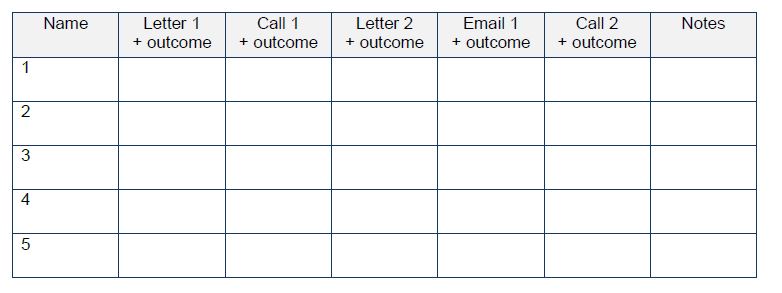
reactivation log

Step 5: Enjoy

Find a way to make the process fun, so you gain buy-in from your team.

Consider launching an incentivised game with rewards.

You might decide each staff member has to contact and reach five people a day, with the goal being to get appointments. Each appointment is worth a point and at the end of the campaign, the points are redeemed for a reward.

Determine what the goal and final outcomes are of the campaign, then determine the points systems and the rewards, and how competitive the game will be.

Remember, to get staff buy-in the rewards must be of value to them, so it may be in the form of a gift voucher or money or individual rewards for each staff member based on their interests.

make reactivation fun


Don’t Leave Money On The Table

Your patient database is a business asset.

If you use it right, you can mine it to boost your patient flow and prevent sleepless nights.

If not, you really are leaving money on the table.

The choice is yours. You can use your assets wisely, increase patient flow, and stop worrying about filling your book.

Or continue as you are, letting people leave your practice, and investing time and money acquiring new patients.

The question is: can you afford to do that?

business asset


Matthew Kimberley is a keynote speaker and a marketing consultant. He trains sales teams and helps very small personality-led businesses get more customers. He is the creator of Professional Persuasion and author of the self-help classic, How To Get A Grip.

In this episode, we discuss:

  • How to triage and fix a leaky sales pipeline
  • How to get 40% increase in sales with Matthew’s persuasive sales technique
  • The real reason you’re avoiding the sales conversation (and how to overcome it)
  • Why you should audition your patients
  • A simple exercise you can do today to better connect with your prospects and increase sales

Find out more about Matthew Kimberley

Website: http://www.matthewkimberley.com/
Twitter: @mjkimberley
Facebook: fb.com/matthewkimberley

You have a secret super power but do you know what it is?

It’s your team and as you’re no doubt aware, they can be a blessing and a curse. A great team can lift your business up and help it soar.

But when a team isn’t coming together and working well, it can seem like a curse. It can suck the time out of your day, drain you of energy and leave you feeling more than a little down.

Your team is a bit like a wizard’s wand.

There are days when you feel as skilled as Dumbledore in Harry Potter. Smartly aiming and firing in the right direction – and getting the results you expected.

Then there are days when you feel a little more like Ron Weasley. You know, the ones where you find yourself virtually spitting slugs.

It can seem like pot-luck but team management is more of a blend of art and science, than it is luck.

There are several keys to getting it right, and I want to take this complex issue and make it easy for you.

So I’m giving you my best infographics on creating a team you can rely on.


Recruit the Right People

Having the right team all starts with recruiting the right people. Here’s my staff recruitment checklist, so you can hire the right person each and every time.

hiring stellar staff


Keep Your Team Engaged

Once you have the right people in your team, you need to keep them engaged and inspired.

In episode 49 of the Savvy Dentist I spoke to Kate Erickson from Entrepreneur on Fire and she talked about building a team you can trust and rely on.

As Kate says, there’s a process of,

“ … really finding the right people, onboarding a team, getting them on board with your mission, continuing to keep them engaged, building that relationship with them so that there is mutual trust and respect there.”

So how do you keep your team engaged, and maintain morale?

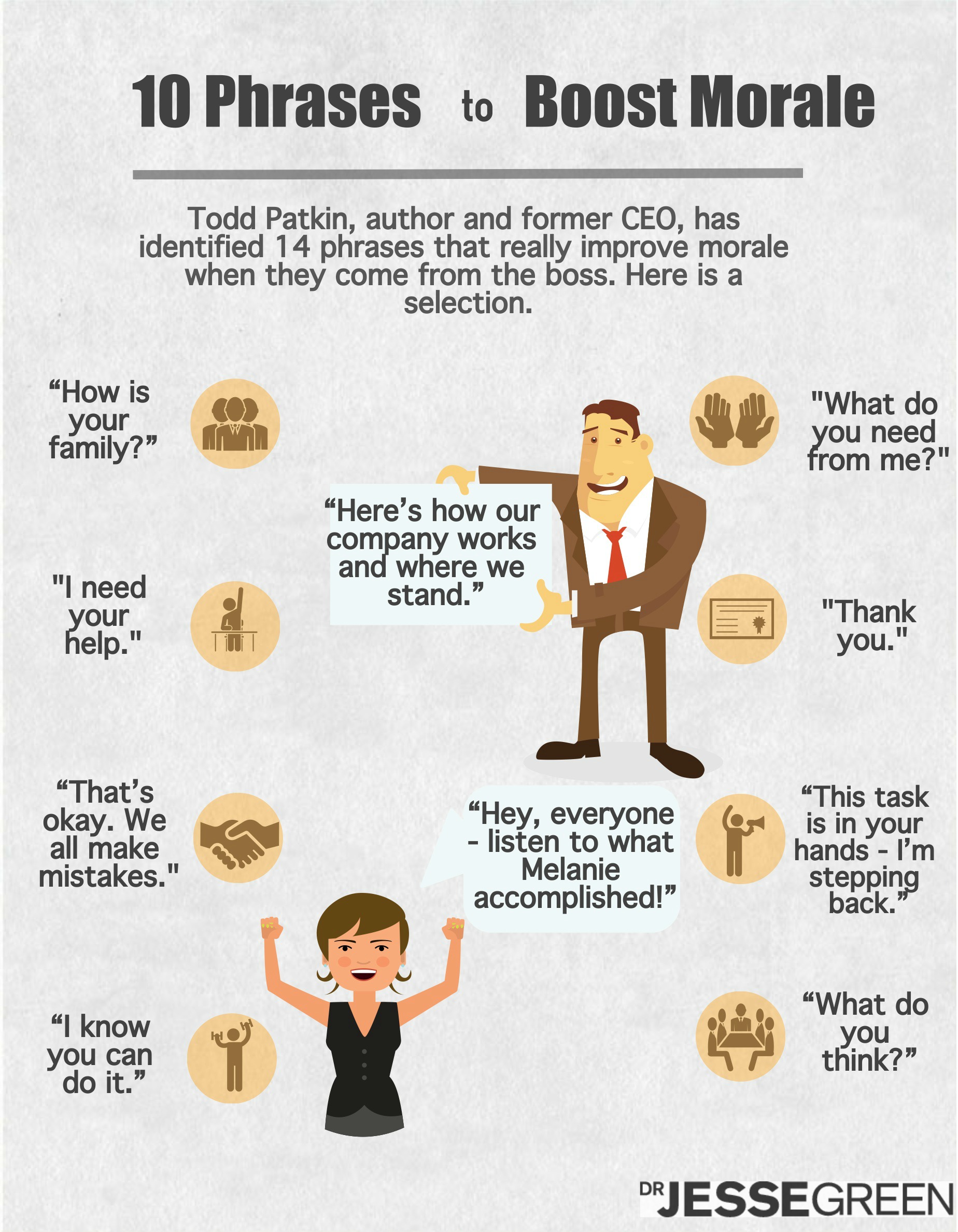
Author and former CEO Todd Patkin says in his book Finding Happiness: One Man’s Quest to Beat Depression and Anxiety and–Finally–Let the Sunshine In, that there are 14 phrases that will boost morale.

Here are a few that you can start using today.

how to get staff to do what you want

Maintain Open Communication

When talking with staff, you need open communication.

You have to be sensitive to other person’s feelings and treat them with respect, but you also need to get your message across. And that can be tricky.

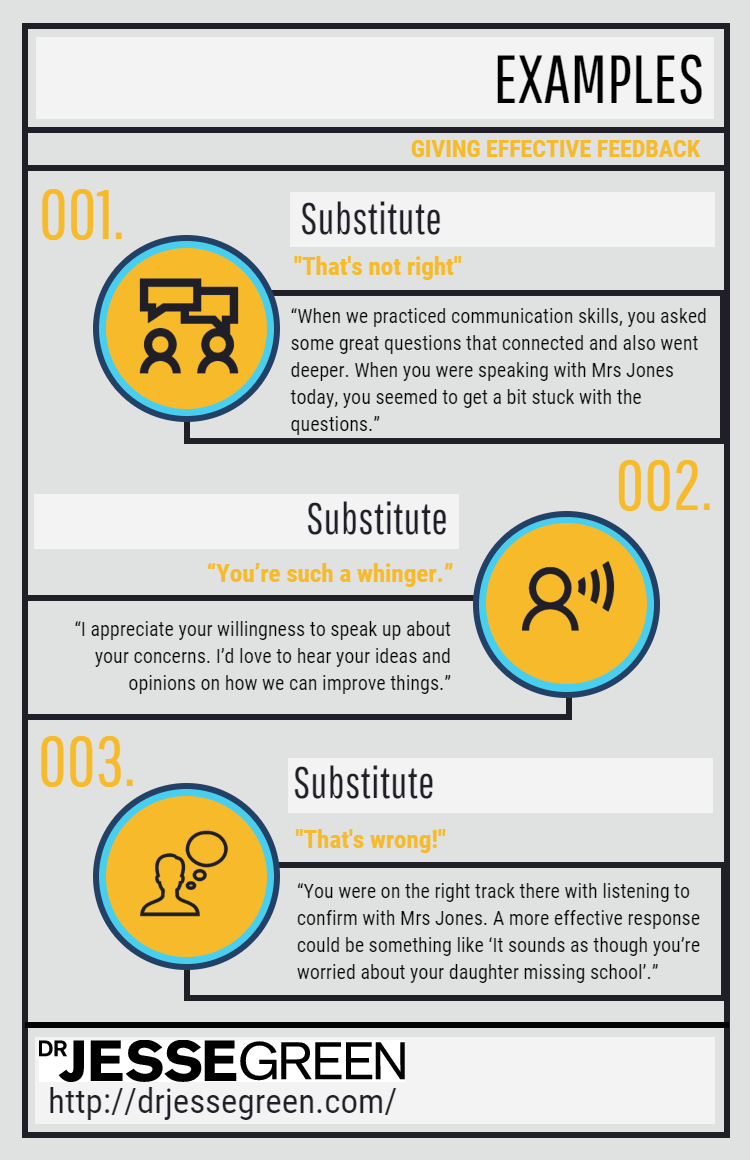
You can help team members to maintain their confidence and self-worth by taking a coaching approach, particularly when giving feedback.

You can do this by:

  • Focusing on the behaviour or issue, not on the person.
  • Respecting and supporting them, even when you feel frustrated and they’re not performing at their best. Practice providing feedback in a way that empowers your team to do better.
  • Not jumping to conclusions and making assumptions. These can damage self-esteem and relationships. Seek first to understand.
  • Keeping a balance between what a person has done well and what he or she can improve upon.

This infographic has some simple examples.

Neg feedback

Inspire Your Team To Do What You Ask

So here’s the thing that I get asked quite often, by frustrated business owners: “How do I make my team do what I want?”

And this concerns me, because I don’t think these people are asking the right question. You see, I don’t want to force people to do what I want.

I want something different and far greater than that.

I want a team who want to help me. A group of supporters who are keen to help out, do their best, and see my business prosper.

Instead of trying to make people do what you want, inspire them to do what you ask. Or better yet, inspire them to see what your business needs and do it without being asked.

Foster your relationship with your team and get to know them well. As Sam Walton said:

“Outstanding leaders go out of their way to boost the self-esteem of their personnel. If people believe in themselves, it’s amazing what they can accomplish.”

Support your team, inspire your team, and believe in your team.

Do this, and they’ll follow you to the ends of the earth.

And you won’t even have to ask.


005