Kate Erickson is a creator, engager and implementer over at EOFire (Entrepreneur On Fire), a 7-day a week podcast that interviews today’s most inspiring and successful entrepreneurs. She is also the host of Kate’s Take: The EOFire Audio Blog and author of The Fire Path: A Beginner’s Guide to Growing Your Online Business. Kate is passionate about helping entrepreneurs create freedom in their business and life through developing systems and processes that can help their business scale and grow.

We chat about:

  • Building the foundations of your business to scale and leverage 
  • How to build a team and keep them engaged 
  • How to stay focused on the things that drive your business forward
  • How daily habits can improve your productivity
  • Why journaling can help you focus on what’s working and what’s not

Find out more about Kate Erickson at


It seems that everyone wants to get more done in less time these days. We’re all crazy-busy and searching for productivity hacks.

Productivity hacks that promise so much but often deliver so little.

Because working in a dental practice isn’t the same as working in an office. You don’t need strategies for getting your inbox to zero, staying off social media or creating a minimalist workspace.

Instead, you need help with making the most of those small gaps that occur during the day, and finding out how to juggle dentistry by day and business management by night.

So let’s find you some strategies that actually work, shall we?

Productivity Isn’t What You Think

Before we get too carried away we need to look at the definition of productivity. The business dictionary says it’s:

“A measure of the efficiency of a person, machine, factory, system, etc., in converting inputs into useful outputs. Productivity is computed by dividing average output per period by the total costs incurred or resources (capital, energy, material, personnel) consumed in that period.”

But productivity isn’t really outputs based.

I prefer Mike Vardy’s definition of productivity. Mike is a productivity strategist and he says productivity is intention + attention.

And this makes sense. Not only that, but you do it every day with your patients.

You’re a productive dentist because each patient that comes in receives your full attention, and your intention is to provide them with the best dental care possible.

If you didn’t give your dental work your full attention all sorts of problems would arise. And if your intention was not to provide the best care but to make as many new friends as possible, your productivity would be significantly affected.

So let’s agree with Mike, that productivity is intention + attention.

Work With Yourself

The problem with many productivity hacks or strategies is that they’re too rigid. They require you to follow a stringent process.

The Personal Efficiency Program (PEP) follows the guidelines Stephen Covey wrote about in The 7 Strategies of Highly Successful People. The problem is that the approach requires you and your team to be trained in the system, and work within those guidelines.

The Pomodoro technique uses time blocks (often of 25 minutes) to work on a task, with short breaks between tasks. But these systems aren’t great for running a business dental practice, and they don’t allow for your own natural rhythms.

Before you adopt any productivity strategies, it’s best to have a clear idea of how you work best.

When are you naturally at your most energetic? What time of day is best for tackling challenging work? When is better for routine work?

Finding a system that is flexible enough to work with your own natural energy rhythms and work style is fundamental. If you don’t do this, you’re unlikely to stick to the new program because there’s too much change involved.

Schedule Your Time

One thing I always recommend to my clients is that they have scheduled admin time during working hours.

Many dentists avoid this because they think it reduces their chair time, and therefore their billable hours. But here’s the upshot.

When you schedule regular admin time during working hours, you’re more productive. My clients have told me that they didn’t believe this in the beginning. But it works.

When you stretch yourself too thin by doing dentistry all day and then business management at night, you become exhausted. This isn’t about ‘balance’ this is about being sensible.

The biggest asset in your business is you. (Click to Tweet)

If one of your team members was critical to your business, would you let them work 12 hour days and risk them experiencing burnout, adrenal fatigue and illness?

No. You wouldn’t. So don’t do it to yourself.

Now, let’s look at how to make the most of your admin time, and how to tackle projects effectively.

Themes Give Flexible Structure

Mike Vardy uses themes to give his work structure, but a flexible structure. Here’s how it works.

You set a theme for each day, to give you focus. You can also have an overarching theme for the month, and you can have modes of work that might run across time blocks each day – such as from 9-10 am each day.

Here’s how this helps you.

When you set your theme for Monday as ‘finance’ then you know that any time you have available on Monday is focused on your finances. If you’ve decided that 12-12.30pm each day is an admin mode, then on Monday your admin would focus on finance.

Maybe you’d pay bills, generate financial reports, or email your bookkeeper.

If you decide that Tuesday’s theme is staff, then you’d use that time to focus on staff issues. Maybe your admin time would focus on placing an advert for a new DA, or writing up notes from a staff review, or writing a job description.

This allows you to focus your attention, but the system is also flexible enough to allow for different tasks. You can also use it in conjunction with other strategies that work for you, such as the Pomodoro technique of working in blocks.

The key is to stick to the themes for each day, and not mix them.

If you find you need to change the structure to better fit your work, that’s fine. But then stick to the new schedule. Don’t mix it up.

(If you want to hear more of Mike’s strategies be sure to listen to this episode of the Savvy Dentist.)

Strategies Can Be Stolen

Tim Ferris has a number of strategies for increasing productivity. Tim is the author of The 4-Hour Workweek and Tools of Titans: The Tactics, Routines, and Habits of Billionaires, Icons, and World-Class Performers.

Tim recommends breaking big projects into the smallest conceivable pieces because they’re less overwhelming. He also recommends making each task as easy as possible.

One simple example is making it easy for people to brush their teeth for 2 minutes each day. Using a timer and keeping track of the seconds is tedious but an electric toothbrush that automatically tells you when you’ve brushed for two minutes makes the task easier.

Tim’s techniques of breaking down projects and making them simple allows you to make the most of those small breaks in your day. It also allows you to harness the power of your team (more on that in a moment).

When you have smaller chunks of work you can also work them into your daily themes and modes.

Routines Really Rock

Mike Vardy swears by his morning and evening routines. They keep him focused and increase his productivity.

Tim Ferris also has a morning routine to keep him focused and productive. In fact, many successful people have a morning routine.

Kenneth Chenault the CEO of American Express has an evening routine where he writes down the top three things he wants to accomplish the next day. Benjamin Franklin asked himself each morning, “What good shall I do today?”

The author PG Wodehouse did callisthenics before his standard breakfast of toast, coffee cake and tea. The novelist William Styron stayed in bed for another hour to think and read.

The point is not what your routine should look like, the point is to create a routine that works for you. Think about the best possible start to each day, and do that.

If you’re focusing on improving your health you might start with exercise. If you want to reduce stress, your morning routine may include meditation.

Whatever it is, create a routine that will set you up for a great day. Every day.

Teams Increase Your Capacity

There are two big mistakes that I see dental practice owners make. First, they fail to delegate effectively and second, they often don’t have a morning huddle.

Delegation is an art and it needs to be done well. The key is to get really clear on what you want to be done, find the right person to do it, and create an action plan.

I know many people struggle with delegating effectively which is why I created a simple infographic that lays out the delegation process, step by step.

When it comes to keeping your team focused, motivated and on track, a morning huddle is invaluable. (Click to Tweet) This is a super short, intense meeting that you have with your team every morning.

Done right, a morning huddle will increase the energy and productivity of your team, keep them focused and improve your patient experience. The key is to do them right, so I created a simple infographic for morning huddles too.

Boost Productivity Without Working Yourself to Death

So now you have an absolute arsenal of tools to boost your productivity, without working yourself into an early grave.

Take the time to create a morning routine that works for you, and sets you up for the day. Work with your natural rhythms and be sure to schedule admin time during business hours.

Try using themes to give yourself flexible structure, and make the most of your team. They’re your secret power to getting more done in less time.

And above all else, look after yourself. Keep yourself healthy and well rested so you can bring you’re a-game each and every day.




Mike Vardy is a husband, father, writer, speaker, and productivity strategist (or “productivityist” for short).

In addition to being the founder and chief writer at Productivityist, he continues to contribute guest articles to several blogs on the topic of productivity, time, and task management. He has served as Managing Editor at Lifehack, and as an editor at The Next Web and WorkAwesome.

Along with his written work, he has given talks on productivity and technology, including a TEDx talk, a panel at SXSW, and facilitating a three-day workshop for creativeLIVE. He currently hosts The Productivityist Podcast, a weekly show that examines personal productivity and tactical approaches to work and life.

In this episode, Mike and I chat about:

  • Theming your days
  • Using modes to batch your work more effectively
  • Productivity myths
  • Morning and evening routines
  • Stacking habits and routines
  • Respecting boundaries and saying no

Links mentioned in the episode:
The 5 Zeros You Should Achieve Every Day to Give You Peace of Mind
https://productivityist.com/savvydentist

Find out more about Mike Vardy

Productivityist website

Twitter

Imagine this.

Your dental practice is thriving. In fact, your patients are your greatest fans.

They’re loyal and devoted and wouldn’t dream of going anywhere else.

Sound too good to be true?

Not at all. In fact, it’s not only possible but relatively simple too.

You just need to know a few simple techniques to build customer value. You see, the key to patient loyalty is to demonstrate the value in your service.

When patients see the value in your service they’re one step closer to becoming raving fans. Think about it.

People who love Apple products know they’re not the cheapest, but they believe they’re great value.

They know there are alternatives, just as your patients know there are other dentists. But they return again and again because of the value they receive.

The Secret To Patient Loyalty

Along with creating excellent customer service, creating value for your patients will mean they’re more likely to attend their appointments.

In fact, creating value has another important outcome. Because not only are patients less likely to cancel, they’re more likely to accept the treatment you propose.

Sounds good, doesn’t it? But how do you do that?

Well, you do that by using every opportunity to describe to the patient what services they are receiving, and how these services help them. This builds patient confidence in what you do.

It also tells your patients exactly why the service is valuable.

For this to be effective, you need to recognise the value that you are providing them. And this can be tricky.

To help you understand the process, here are some examples of how I build value in my practice.

You’ll notice that value is built into every interaction, or as many interactions – also called touch-points – in the practice as possible.

Describe

Your Step-By-Step Guide

Before Treatment

Before you start treatment, it’s important to build value for what you’re about to do. (Click to Tweet) Let’s imagine Mrs Jones is here for her appointment. Before starting any treatment I would say to her:

“Mrs Jones, today we’re going to be completing a restoration on the upper right hand side. It’s important we’re getting onto this today because left untreated, this tooth could easily become problematic.”

This ensures that Mrs Jones understands what’s happening and knows that you are helping to maintain her great dental hygiene. This is valuable for her.

During Treatment

While you’re conducting treatment, you can reinforce the value you’re giving by saying:

“Mrs Jones, I’m really glad we’re doing this restoration today. The cavity is quite large and if we’d left it any longer, it would almost certainly have caused you problems.”

While this may seem like repetition, it really isn’t. It’s confirming to Mrs Jones that the cavity really is large and that it would have caused problems if left any longer.

After Treatment

Once you’ve completed the procedure, you can build value for the work you’ve just done by saying:

“Mrs Jones, I’m really pleased we completed the restoration today. Once I opened up the cavity it was quite deep and if it had been left too much longer, it would almost certainly have caused you problems.”

Again, this is not as repetitive as it may seem. It’s really validating the situation so the patient understands you’ve got her best interests at heart.

At Reception

I would turn to my receptionist and say:

“Mary, Mrs Jones has done really well today. We have done a really large restoration for her on the upper right first molar. It was good that we were able to complete that today because otherwise it could well have caused a few dramas if we’d left it. Mrs Jones has another cavity on the lower left second molar and I’m worried that if it is left too long it could also lead to problems. I’m anxious to complete that as soon as possible.”

I would then address Mrs Jones again:

“Mrs Jones: so that you don’t have any nasty problems, it is important that we address the decay in the lower left second molar. Mary will make a time for you to come in and get that fixed up. Do you have any questions for me before I leave you with Mary?”

If Mrs Jones did not have any further treatment that needed to completion, we would look to build value for the next recall examination instead. So we might follow up by saying something like:

“Mrs Jones, you don’t need any more dental dramas. So that we can ensure any problems are dealt with early, easily and conservatively, I’d really like to see you in September (i.e. six months’ time) for your preventive maintenance examination. Cavities can develop pretty quickly and I’m concerned that if we leave it any longer we’re running the risk of seeing more cavities like the one we had today. I’m going to ask Mary to schedule an appointment for you and at least then it is in the diary. If circumstances change, we’ll handle that. It’s important this doesn’t fall through the cracks.”

I then leave Mrs Jones with Mary, to make her next appointment, which is also a structured conversation designed to gain a commitment from the patient to attend the next appointment.

Making Appointments

Mary: “Mrs Jones do you have any day of the week that don’t work for you in terms of scheduling an appointment?”

Mrs Jones: “Tuesday and Friday’s are not so good for me. I travel with work those days.”

Mary: “And do you prefer a morning or afternoon appointment?”

Mrs Jones: “Morning please.”

Mary: “Mrs Jones I have Monday at 9 am or Wednesday at 10:30 am. Which of those suits you best?”

Mrs Jones: “Wednesday at 10:30 am please.”

Create Your Own Success

It really is simple to create value for your customers, and the flow-on effect is increased patient loyalty. (Click to Tweet)

Start creating value for your patients now. This needs to become part of your practice culture, so you can build a successful, secure practice for you, your staff and your patients.

Pretty soon that dream of a thriving dental practice will be a reality.

You’ll have created patients that are your greatest fans. Patients that are devoted, and loyal, and rave about you everyone they know.

You’ll have created your own success.

And there’s nothing more satisfying than that, is there?


Create value

In this episode, I chat with Verne Harnish. Verne is the founder of the world-renowned Entrepreneurs’ Organization (EO), with over 11,000 members worldwide. He is also founder and CEO of Gazelles, a global executive education and coaching company with over 180 partners on six continents. Verne has spent the past three decades helping companies scale-up.

In today’s episode, we chat about:

  • The 4 key elements that determine why some businesses make it and others fail
  • Why you should never make a decision alone
  • Ways dentists can compete and scale in a competitive market
  • Expert customer service tips
  • Finding ways to scale when you love your own craft
  • Why you need a daily huddle
  • and more

Get a copy of John DiJulius’ Secret Service

Sign Up for Jesse’s Workshop

Find out more about Verne Harnish

https://scalingup.com/

Growing a dental practice can be as overwhelming as getting dumped in the surf.

It can seem like a swirling mass of priorities. It can be hard just to work out which way is up.

And it’s easy to get sucked into what other people are doing and wonder if you should take the same actions.

Well here’s a something you might not know. All practices go through the same stages of growth.

How is that helpful?

Well, each stage has certain characteristics. And each stage has priorities that you should focus on to achieve growth and stability.

So, if you know which stage of practice growth you’re at you can gain clarity. You can understand the priorities for that stage and propel your business forward.

For example, dentists in the start-up phase usually spend an extraordinary amount of time doing everything.

As they get their dental practice management, marketing and systems in place, they take a step back.

Let’s take a look at the five stages of dental practice growth so you can work out where you are, and where you should focus your energy.

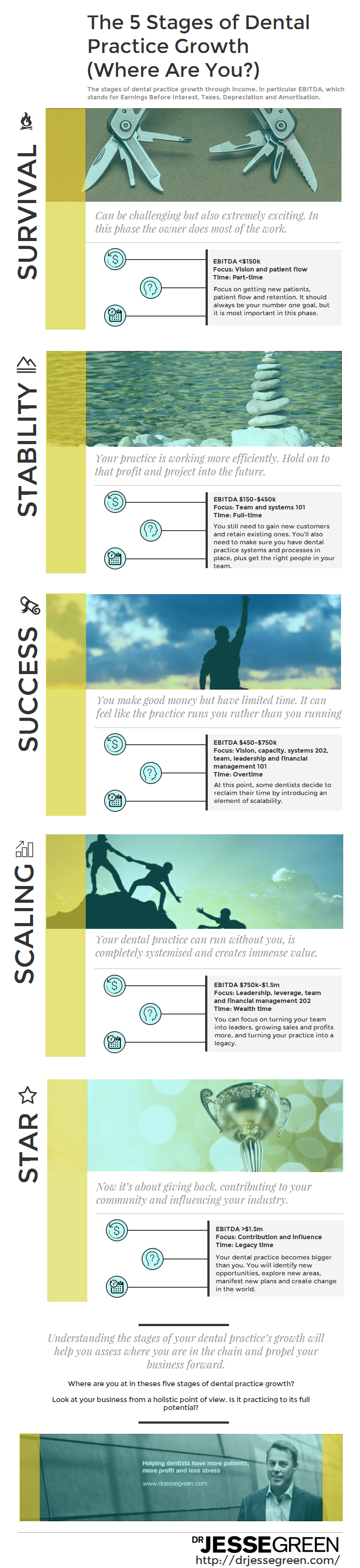
We’re going to look at the stages of dental practice growth through income, in particular, EBITDA, which stands for Earnings Before Interest, Taxes, Depreciation and Amortisation.

5 Stages of Dental Practice Growth

5 stages of dental practice growth

Knowledge is Power

Now you know where you’re at on your journey to grow your business.

You can kick confusion to the kerb because you have clarity. You know your priorities, and how to get to the next stage of business.

You know whether your business is practising to its’ full potential. Knowledge is power, so harness this newfound knowledge.

Take charge of your business and your destiny.

What’s that you say? “It’s not that easy!”

You’re right. It’s not easy at all.

Knowing the theory and putting it into practice are two totally different things. That’s why I’m offering you a golden opportunity to join me at my next Practice Max Intensive, Profitable, Scalable, Sellable.

My events are normally reserved for my coaching clients but I’m offering a limited number of spaces to this one event.

The bad news is that once the seats are gone – they’re gone. Wait, there’s more bad news because we’re inviting hundreds of people to this event even though we only have a couple of dozen spaces.

So check availability and get in while you can. Registrations close this Friday at 5 pm Sydney time. No extensions. No exceptions

You have the power to change your business and your life. Use it wisely.


In this episode, I chat with the author of The Smart Business Exit, Geoff Green. Even if you’re not thinking about exiting anytime soon, this episode is jam-packed with information on how to build a profitable and scalable business through exit planning.

For over 30 years, Geoff has been helping business owners not only build great businesses but also get rewarded for their blood, sweat and tears when they exit.

Geoff provides strategic guidance to a number of private businesses in his roles as director and advisory board member. In particular, Geoff is a member of the international advisory board of The Value Builder System, which provides a highly effective process for improving the value and sellability of private businesses. It is also one of the world’s largest and fastest-growing networks of business exit advisers.

In this episode we cover:

  • 3 types of business owners (which one are you?)
  • Why profit is only one component of the value
  • How preparing for sale improves your business right now
  • Different types of value – recurring revenue, hub and spoke
  • Why you should be viewing your business through the eyes of a buyer
  • Advice for those who are exiting soon
  • And more!

Register for Profitable, Scaleable, Sellable: www.drjessegreen.com/nailit

Find more about Geoff Green

GRG Momentum website: http://www.grgmomentum.com.au/about
LinkedIn: https://www.linkedin.com/in/geoffgreenthesmartbusinessexit/

Buy yourself a copy of The Smart Business Exit book.

Hanging out your shingle doesn’t guarantee you’ll create a profitable, scalable, sellable practice. And being a great dentist isn’t enough to build a successful business either.

It doesn’t guarantee you any income at all. In fact, being in business only guarantees one thing and that’s a huge investment of time and money.

How do some people seem to find it easy to create successful practices? How is it that some people can sell their businesses for so much more than others?

What is it that successful people know – what’s the secret?

One secret is that you should always be building your business to sell, even if you have no intention of selling it yet. In fact, the book Built to Sell states:

“If you want to sell your business for the maximum amount of money, it needs to be designed to thrive without you so the next owner can continue to grow and profit from your hard work when you’re gone.”


Create a Business That Thrives Without You

A business that thrives without you is more likely to sell for a higher price than one that revolves around you. So how do you create that?

In a word: systems. You need to create documented processes and procedures for your team to follow.

That way the business is not reliant on you. And things are done to a similar standard, in a similar way, each and every time.

You can start creating a great customer experience because you have processes and procedures. You can spend less time and energy constantly reinventing the wheel.

There are less mistakes. And the big bonus?

When you build your business to thrive without you, you are no longer tied to your business. You can delegate effectively. You can take a holiday without spending the whole time worrying.

And another big benefit is that you can scale effectively. Because in order to scale you must have successful dental practice management, marketing, and systems in place.

Create a Business You Can Scale

First of all, let’s get clear on the models your business may fall under:

  1. Sole practitioner (owner) – the traditional way practices operate
  2. Owner/practitioner plus an associate dentist (plus or minus auxiliaries)
  3. Creating excess capacity – for example, extending opening hours, split shifts, employing additional people and opening multiple locations

A scalable business has the potential to multiply revenue with minimal incremental cost.

You might have a ready-to-scale business that has a proven product or business model and is ready to expand into new territory. This could include new locations or even a different target market or industries.

When you are building a business to sell, your dental business coach will advise you if it needs to have an element of scalability. You might create capacity through innovative scheduling, employing more people or opening extra locations.

Any of these options require a different skillset to the traditional model of practice.

As you scale up you need to learn to build and lead teams. You must know your metrics and be able to produce “teams of income” rather than multiple “streams of income”.

It also takes in your dental practice management, dental marketing, and dental practice systems.


Create a Business You Can Sell

Your methods need to be teachable by someone who is not you and that’s because you must be thinking about taking yourself out of the business.Remember: you won’t be there when you sell.

Remember: you won’t be there when you sell.

A sellable business is one that creates plenty of value for patients (and that value is not easily repeated by others). This will help show you have combatted the number one profit leak in many dental practices today, which is patient retention.

Most small businesses are family owned and operated and can be very successful, satisfying and small without being scalable.

But if your passion is to create a practice that is scalable without burning out, if you want a profitable business and a life as well, then you need to create and implement strong business systems.

Don’t Do It Alone

Creating a fully systematised business is hard, but I want to help you.

My passion is to help you succeed.

I want you to experience the success you desire, and create the business and life that you’ve always dreamed of.

That’s why I’m opening up a limited number of places at my next Intensive, Profitable, Scalable, Sellable.

My events are normally reserved for my coaching clients, but we’re offering a limited number of spaces at this one event. Once they’re gone, they’re gone – so grab a ticket while you can!

Get all the details on the Profitable, Scalable, Sellable registration page.

You deserve to create a business and life you love!


On this episode, I’m joined by founder of Bean Ninjas and business growth and systems whizz, Meryl Johnston. Meryl has embraced the true art of business ownership. If you want to know how to scale and grow your business or want to get tips and insights into accounting for dentists, this episode is for you.

Meryl is a Chartered Accountant. She started her career in the audit division at BDO (Melbourne), followed by a number of years in commercial roles and a stint as a lecturer in accounting and audit.  Meryl is a keen surfer and can often be found at her home break at Palm Beach on the Gold Coast.

We talk about:

  • The phenomenal growth of Bean Ninjas
  • Transitioning into real business ownership from the owner-operator mindset
  • Building a team
  • The importance of key drivers
  • Streamlining your bookkeeping to free up your time

And much more.

Upcoming Workshop: Profitable, Scalable, Sellable

23-24 February 2017 – Surfers Paradise
Register here: drjessegreen.com/nailit

Find out more about Meryl Johnston:

Bean Ninja’s website: https://beanninjas.com/
LinkedIn: https://www.linkedin.com/in/meryl-johnston-3a483728/

It’s not a fairytale.

You can create an efficient business that can run smoothly and efficiently – even if you aren’t there. Sounds appealing, doesn’t it?

But there’s one catch. You have to have smart systems in place.

So what exactly are systems?

A system, with standard operating procedures (SOP), is a detailed step-by-step guide on how to complete a certain task. It can be documented in written form or using multimedia options such as video or audio.

Smart systems – that is operating systems, policies and procedures – are essential because they:

  • Allow your business to be less reliant on star performers
  • Can multiply across different locations
  • Make leveraging possible
  • Represent the development of intellectual property assets
  • Make your business more valuable to prospective suitors
  • Ensure the practice owner is no longer the source of all knowledge – freeing up their time

More importantly, they can make all your dreams comes true. That is, assuming you dream of owning a profitable practice that runs smoothly without you having to lift a finger.

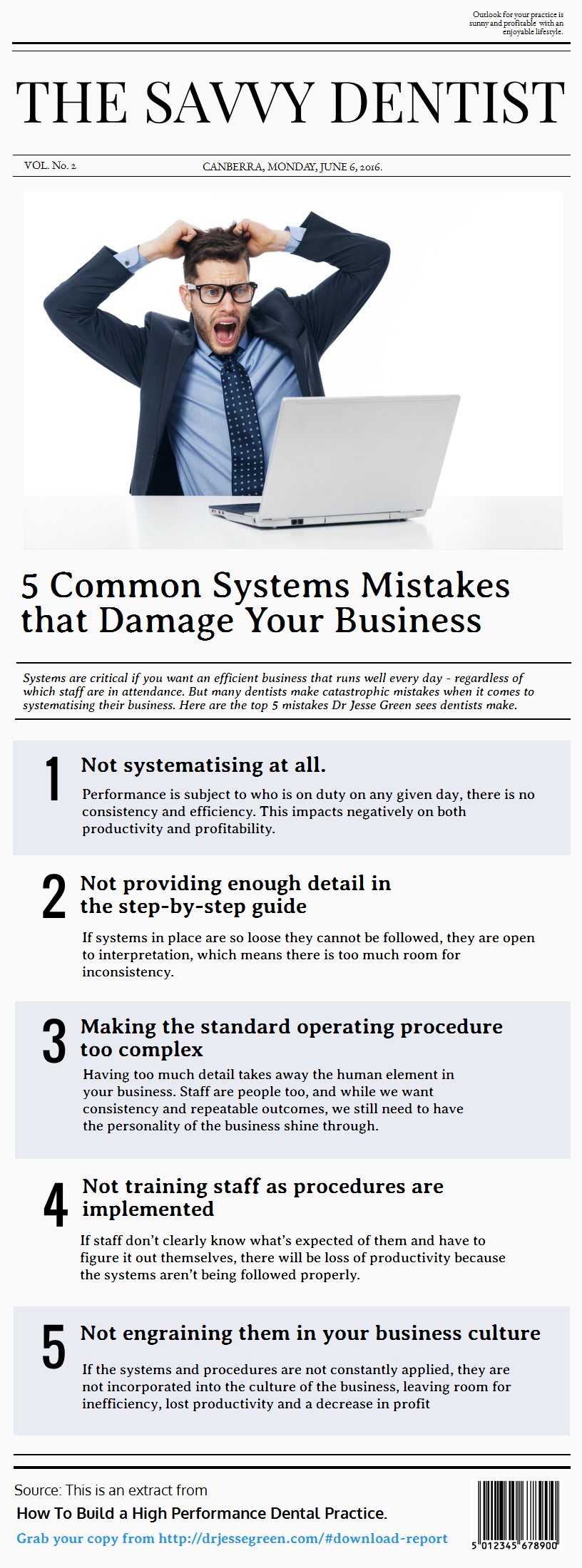
Unfortunately, I see many practices making catastrophic mistakes when it comes to systems. And these mistakes can have a major impact on your business.

So let’s examine the major systems mistakes and look at how you can rectify them.

Common mistakes v2


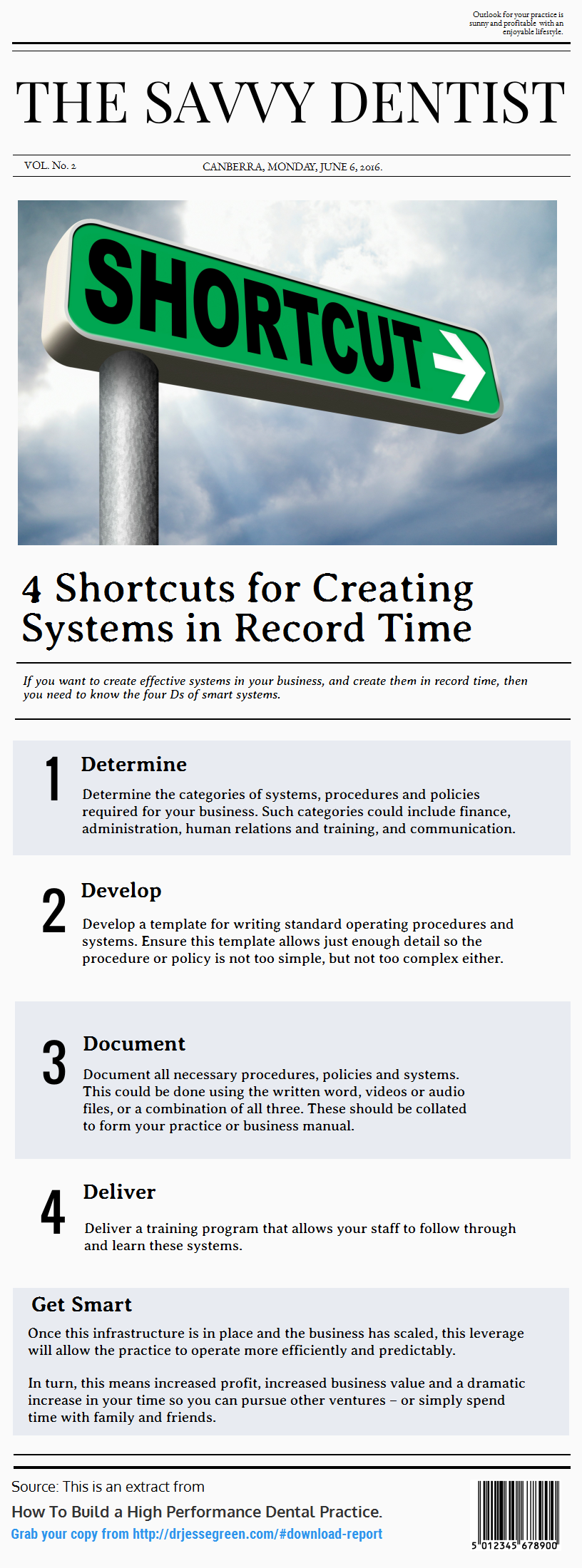
Now that we’ve reported on the systems mistakes people make, let’s look at some good news. Systems can be simple to implement in your business.

Here’s how.


Shortcuts v2

How to Avoid Sytems Mistakes and Get Your Business Running Like Clockwork

You know that fantasy you sometimes entertain? The one where you can take a break from your practice and not have to worry about things falling apart in your absence?

That can be a reality.

You just have to implement systems. And the great thing is you don’t even have to create your systems yourself – I can help you.

If you want to get organised and create a business that runs effectively without you, I can show you how.

I’m offering a limited number of places at our next Intensive, Profitable, Scalable and Sellable.

My events are normally reserved solely for my coaching clients. But I want to help more dentists create successful practices they can scale – without getting burnt out.

Whether your practice is relatively new or well on its way, if you want a successful practice that thrives whether you’re there or not, you must not miss the Profitable, Scalable and Sellable Intensive.

After you attend you can plan that holiday in the sun, without a worry in the world!

Profitable Scalable Sellable