Poor patient flow leads to unfilled appointments.

They’re time – and money – wasted.

Of course, you have plenty of things to occupy your time, but that’s not the point.

Running a business is always going to keep you fully occupied. But what you want is billable hours.

And unfilled appointments are frustrating because you’re not able to charge for that time.

You have plenty of patients on your books, it’s just that they don’t always come in consistently.

What you need is better patient flow.

You don’t need people slipping through the cracks. Dropping off you books. Or failing to complete their treatment.

It’s not good for their oral health, but it’s not good for your cash flow either.

And that’s what you want.

Good, consistent patient flow so you get good consistent cash flow.

It makes life easier for you, for your staff, and for your business.

But how do you create consistent patient flow? Can you create it?

Or do you have to sit and wait for the phone to ring?

I believe you can manage patient flow.

If you and your team work together, you should be able to keep your appointment book full.

So how do you do that?

Well, there are a number of ways, but I’ll give you a few to get started.

This list is not exhaustive. It’s not designed to be a comprehensive marketing plan.

It’s simply 7 ways to jump start patient flow.

1. Check Your Recalls

Check that all your recalls have been sent and follow up on nonresponses. You can also use an incentive to come in.

The sort of incentive is up to you, and will depend on your business and your brand. You could consider dental dollars or Viva Cards if that is appropriate for your ideal patient persona.

2. Reactivate Your Records

Take a look through your records and make a list of anyone who has not had an appointment in the last 18 months.

Audit the patient files. A healthy general practice will have approximately 1,500 patients per full-time general dentist.

Develop a script for the call before making it and again, consider an inducement to re-activate. It is about re-connecting and re-establishing the relationship.

3. Refer A Friend

Refer a friend programs are highly effective, particularly if you do them well. They can help you create more ideal patients.

The key is to approach current patients that you enjoy working with – your ideal patients – and make them feel special and valued.

Again, consider using Viva cards and rewarding the referral.

4. Complete Outstanding Treatment

Ask your Practice Manager to go through your files and look for any treatment that has been planned and not completed. Then make contact with those patients and invite them back into your practice to complete their treatment.

In order to do this well, it’s a good idea to develop a clear script before the call.

The key to doing this elegantly is to make the patient feel special. You don’t want to give them the impression that you’re trying to fill gaps in your appointment book.

5. Catch Out Of Hours Calls

Ensure that after hours calls are diverted to your mobile. Why?

Because these inquiries need to be converted into appointments. If a practice is open 9-5 Monday to Friday it is open for 40 hours per weeks.

That’s 40 hours of a possible 168 hours which represents 24% of the week. What happens in the remaining 76%??? Will people call out of hours…yes!! You need to capture these.

6. Turn Sales Reps Into Patients

When a sales rep tries to sell you something, have your receptionist let them know you’d be happy to do business with them and that you have a policy of doing business with those who do business with you.

Let the receptionist ask if they have a dentist and sing your praises before asking them if they would like to make an appointment.

7. Convert Cold Callers Into Raving Fans

You don’t have to be the world’s best salesperson to convert cold callers into raving fans. You don’t even have to use any slimy, salesy speech.

You really just need to give your callers the information they need, in addition to what they ask for.

Great telephone skills can convert inquiries to appointments, and then to loyal patients.


Kickstart Patient Flow

Filling your appointment book doesn’t have to involve an expensive external marketing strategy.

It can be as simple as tweaking your processes so you retain your existing patients.

In fact, your long-term strategy should be to develop deep, meaningful relationships with your patients.

Because it creates loyalty.

Patients who are fiercely loyal won’t consider seeing another dentist. And they’ll sing your praises to anyone who’ll listen.

So your loyal patients will not only be devoted and happy, they’ll be out there marketing your services.

And your appointment book? Well, you won’t be seeing gaps anymore.


boost patient flow

In this episode, I speak to Dr Derek Mahony. Derek is a Sydney based Orthodontist who has spoken to thousands of practitioners about the benefits of interceptive orthodontic treatment.

Derek has over 3,000 orthodontic patients in active treatment. He has been a keynote speaker at:

  • the International Orthodontic Summit meetings
  • the International Association of Orthodontics meetings
  • the American Association of Functional Orthodontics meetings.

In this episode we chat about:

  • The importance of having a unique selling point
  • The benefits of being a disrupter in the orthodontics space
  • The amount of work – there’s enough for everyone
  • The rise of group practices
  • The trends Derek sees emerging in Australia
  • The opportunities available in this time of change
  • How to master the art of delegation
  • The pitfalls and lessons Derek has learned
  • How to build and train an effective team

Find out more about Derek Mahony
Website http://www.eodo.com/
LinkedIn https://www.linkedin.com/in/drderekmahony

There’s a shortcut to success.

Part of being successful is making mistakes and learning from them. But what if you could learn without having to make mistakes?

What if you could avoid having to suffer the setbacks and the angst?

What if you could take a shortcut to success?

You can, and it’s really fairly simple.

Don’t just learn from your own mistakes, learn from the mistakes that other people make. (Click to Tweet)

To help you, I’ve put together a list of 7 big mistakes business owners make. Take a look at what to avoid so you can shortcut your success today.


1.  Working in The Business But Not on The Business

This is a big one and as a dental practice owner, it’s an easy trap to fall into. You’re so busy with patients that you fail to set the strategy for the business.

This means your business is like a boat without a rudder – it’s at the mercy of the tide. So you’ll go wherever the water takes you.

Some people address this by working in the business by day and working on the business at night. That’s a fast track to burnout and exhaustion.

Learn from this mistake by setting aside dedicated time each week to work on your business. Yes, it’s time that could be spent generating income, but people who do this reap big rewards.


2.  Underestimating Communication

Effective communication is the key to success in all aspects of life. It’s key to having strong personal relationships and it’s critical to running a successful business.

Many practice owners underestimate the power of communication, but it’s crucial for improving case acceptance.

It’s also vital for creating an effective, efficient team to support you. One of the major communication tools I use is the morning huddle.

Take the time to nail the morning huddle. It gets every day off to a fantastic start because you and your team are motivated and focused.


3.  Ignoring Poor Staff Performance

You can’t afford to ignore poor staff performance and just hope it goes away. It doesn’t.

The best thing you can do is to have an honest, respectful conversation. Lay out your concerns and your expectations.

Try to get to the bottom of the problem. Maybe the person isn’t clear on their duties. Maybe they don’t know your standards.

Whatever it is you need to understand what’s going on and the staff member needs to understand that more is required.

Fostering an authentic, trusting relationship take work but it’s worth the effort. It’s the foundation of a high-performing team.


mistakes are dues


4. Underestimating the Value of Customer Complaints

Customer complaints are a valuable opportunity for you to learn what might need improving in your business. (Click to Tweet)

Don’t make the mistake of ignoring them and believing they’re the voice of the disgruntled few. All too often the people who complain are voicing a concern that many patients experience.

Every time a customer complains you have a golden opportunity to improve your business. You also have the chance to turn a complaining customer into a devoted follower.


5. Failing to Implement Systems

Part of running a successful business means that you’re able to take a break from time to time. Without spending your whole ‘holiday’ on the phone to the office.

We’ve all been there, but it’s something that’s avoidable. And the way to avoid it is to implement clear systems throughout your business.

This means you’re not reliant on individuals. Instead, you’re relying on tried and true processes that have been mapped out and written down.

Don’t make the mistake of failing to implement effective systems in your business. Use my shortcuts to creating systems in record time.


2


6. Marketing Without Strategy

If you don’t have a marketing strategy you’re committing one of the 7 deadly sins of marketing. And if you’re spending money on marketing when you don’t have a strategy, you’re throwing money away.

There are a bunch of mistakes that business owners make when it comes to marketing. They’re not difficult to avoid, but you need to understand your target market and have a clear plan.

You should also have a good internal marketing strategy in place. Why? Because your team are one of the best marketing tools you have.

Use them to your full advantage, so they generate business for you.


6. Not Being Financially Savvy

As a business owner, it’s imperative you’re financially savvy.

This doesn’t mean you need a degree in accounting. It means you need to know what to measure, how to measure it, and monitor it throughout the year.

You need to be proactive in your approach. That means having a process for gathering the relevant data, analysing it, planning, forecasting the year ahead and tracking your progress

You need to set plans in place to improve your performance for the following year, and your financial data is key to this improvement.


mistakes are an opportunity to learn


Avoid The Mistakes Business Owners Make

It’s okay to make mistakes because they help us learn, but if you want a shortcut to success, learn from the mistakes that other people make.

Take time out to work on your business, and invest time and energy in communicating well.

Understand the benefits of having strong systems in place, and value customers who complain.

Most of all, make sure you know, track and understand your numbers.

Avoid these 7 mistakes business owners make and you’ll be well on your way to success.

I know you can do it. And so do you.


Dr Nauv Kashyap joins me for the last episode of a 3-part series on the Stages of Practice Growth. The series focuses on what you need to be doing so you can progress through the stages at a good pace. In this episode, we talk about mastering case acceptance so you can grow your practice.

Nauv is the founder of Practice Ownership Consulting, Australia’s first dedicated consulting business to help employee or associate dentists explore practice ownership. Many dentists have become practice owners and achieved excellent results with Nauv’s help. Nauv provides expert guidance as they take on the challenges of ownership.

Nauv bought his first practice in 2008 with approximately $400K a year turnover, and 2,500 patients. That practice has seen more than 20,000 patients. In 2015 it will turn over approximately $2.5million. Nauv has also started a further ten dental practices and sold a number of practices. He continues to find opportunities for successful start-ups and takeovers even in a saturated market.

In this episode we talk about:

  • Why not all revenue is equal
  • Elegant case acceptance principles
  • The purpose of a treatment plan
  • Techniques for mastering case acceptance
  • What unethical case acceptance looks like
  • Common case acceptance mistakes and how to avoid them
  • 3 ways to increase revenue
  • The importance of building a relationship with new patients
  • What Google has to do with mastering case acceptance

And more

Where to find Nauv

Website: http://practiceownership.com.au
Linkedin: https://au.linkedin.com/in/nauvneel-kashyap-04041b4b

Conflict.

What does that word make you think?

Some people want to ignore conflict and hope it goes away. They take the “Bury Your Head In The Sand” approach.

They know it doesn’t work, but they dislike conflict. Truth be told they’re a little afraid of it.

Then there are the people who love a good argument. They’re happy to defend their corner because they know they’re right.

Unfortunately, being ‘right’ isn’t great for relationships. It can permanently damage rapport and lead to further problems.

Workplace conflict is also a big drain your business. A 2008 study questioned 5,000 full-time employees in nine countries around Europe and the Americas.

They found that 25% of people call in sick or stay away from work because of workplace conflict.

The primary causes of workplace conflicts are personality clashes and warring egos (49%), followed by stress (34%) and heavy workloads (33%).

The study also found that the average employee spends 2.1 hours a week dealing with conflict. That’s about one day a month!

Unfortunately, there’s a big discrepancy between how well managers think they handle conflict, and how well others think they handle it.

Nearly a third (31%) of managers think they handle disagreements well, but only 22% of non-mangers agree.

Given the impact this can have on your business, it’s important to handle conflict effectively.So how exactly do you do that?

So how exactly do you do that?

Well, I’ve found there are six keys to managing conflict effectively.

resolving conflict in record time

The Key To Resolving Conflict

These techniques will help you resolve conflict effectively and even elegantly. But there’s something missing.

You see, there’s something that you need to find inside yourself so you can handle conflict well.

It’s something we don’t often use.

It’s something society needs more of.

It’s something that is worth the effort every time you drag it out and dust it off.

That thing is your courage. As Winston Churchill once said:

“Courage is what it takes to stand up and speak; courage is also what it takes to sit down and listen.”

You need to have the courage to face conflict before it escalates.

You need to have the courage to set aside any ideas of ‘right’ and ‘wrong’ and instead search for solutions.

You need to have the courage to suspend judgement, avoid blame and listen calmly.

So the next time conflict rears its’ head in your world, dig deep and find the courage to deal with it effectively.


Your website is a marketing tool. Does your website get your practice phone ringing? What makes a website good? How do you make sure your website is working for you?

In this episode, I chat with Jon Hollenberg. Jon runs a web design business called Five by Five. He is the author of “Love at First Site – A No B.S Guide To Getting Your Website Firing”. Jon started life doing web design but now leads a team of talented designers, developers and content marketers delivering powerful web solutions. He works with small to medium business owners to make them a rock star online.

The ultimate result is a website that gets the phone ringing and your inbox full of enquiries. With over 18 years experience Jon has delivered over 1,000 websites working with brands such as Qantas, Jetstar and Jeep, Chrysler and Dodge.

In this episode we talk about:

  • The elements of a good website
  • Which website software to use
  • Current design element trends
  • How to brief a designer
  • What content you should be putting on your site
  • SEO considerations
  • How to measure the success of your site with Google Analytics, and more.

Find out more about Jon Hollenberg

Website www.fivebyfive.com.au
LinkedIn https://www.linkedin.com/in/jonhollenberg
Twitter: https://twitter.com/fivebyfiveweb

Here’s the bad news.

You can’t make your staff do what you want. You’ve probably heard the old phrase, “You can lead a horse to water, but you can’t make it drink”.

The same thing applies to people – whether they’re your staff, your partner or your kids. You can’t make people do what you want them to do.

I mean, you can try the old “It’s my way or the highway” routine, but you know where that will lead, don’t you?

It will lead to staff who put up and shut up long enough to find a new job – and they’ll leave you in the lurch if they can.

You won’t work in a fun, relaxed environment. And guess what?

Your patients will pick up on that. They’ll also notice your staff turnover, and that always leads to patient turnover as well.

So you can’t make staff do what you want. But that’s not the end of the story.

Because that’s not really what you want. You don’t want to force people to do your bidding. Not really.

What you want is for your staff to want help you. You want them on your side, promoting your business, and cheering for your success.

You want them to be your supporters, so they’re keen to help out and do their best.

And there are some relatively simple ways to achieve that.

Build Strong Relationships

If you have strong relationships with each member of your team, you’ll be able to bring out their best.

Think about it. You’re more likely to go out of your way to help people you know and care about, aren’t you? The same goes for your team.

So make the effort to get to know each of your team members personally and develop strong relationships with them. This increases loyalty and fosters a sense of belonging.

It takes a little time to develop strong relationships, but it’s an investment worth making because it pays dividends. It reduces staff turnover and increases patient retention.

Read Your Team

When you know your staff well you’ll be able to ‘read’ them. You’ll know their strengths and weaknesses, and you’ll know what motivates them.

You’ll understand who needs more support and guidance, and who can be given brief direction. No one likes to feel as though they’re being micro-managed, but nor do they like to feel as though they have no support at all.

As a leader, you need to navigate these murky waters. You need to understand which staff require close monitoring, and which don’t.

Some of us need more assistance when we’re learning new things, or stretching our boundaries, but some don’t. Just as a parent knows their own child, you need to know your team.

It’s up to you to recognise how much support each person needs, and when they need it. But, if you’re ever in doubt it never hurts to ask!

Ask, Don’t Tell

This seems obvious but asking someone to do something is very different from telling them to do it. When we’re in the heat of the moment we can forget how we’re interacting with people, so it’s worth checking with yourself.

How often do you ask your team members for help, rather than telling them what to do? How often do you thank them for their effort?

If you want to foster respect from your team you need to show them the same respect. We teach other people how to interact with us every day – in the way we interact with them.

Think about it.

When someone is friendly and light-hearted, we tend to be that way too. But if someone is grumpy and demanding, it brings out those traits in us as well.

So be courteous and considerate with your team, and they’re more likely to show you the same consideration.

Aim For Outcomes

Do you find yourself having lengthy discussions about how things should be done? Well, not every staff member needs that – some do, but some don’t.

This is why you need strong relationships with your team, and why you need to read them, and know the support they need.

If you have team members who are independent, conscientious and capable try saying, “Here’s the outcome I want”. Then tell them the result you need them to aim for, rather than focusing on how they can achieve that result.

This is a great strategy that I use often, but it comes with a warning. You need to know the person well before using it.

This is not something I’d use with a new person who was still getting used to their role, and it’s not applicable to everyone. Some people need more direction than others, so use it wisely.

I know you’re smart and you don’t want to set people up for failure. So use this strategy with people who are competent, and have the knowledge to step up to the challenge.

Boost Morale

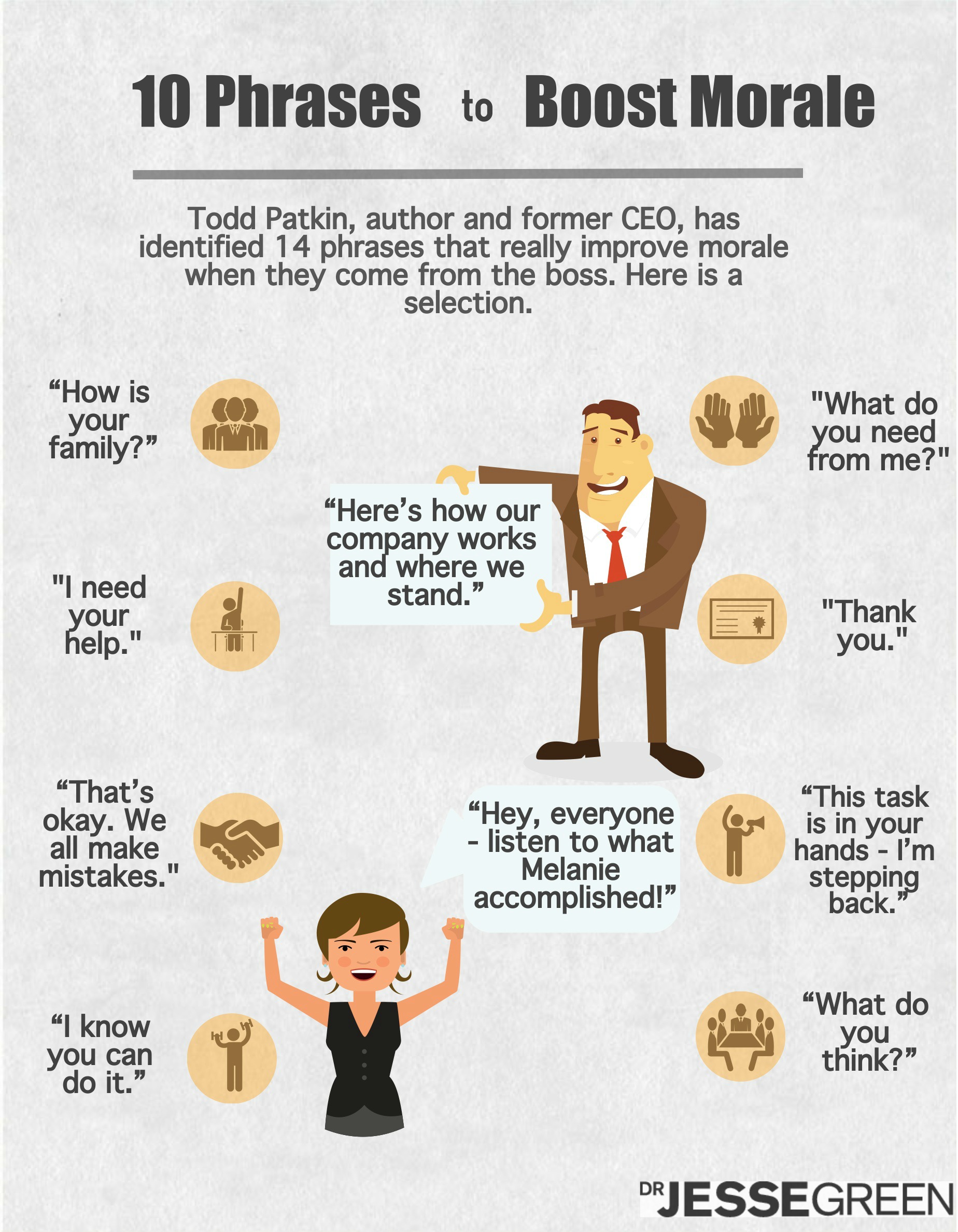
Author and former CEO Todd Patkin outlines 14 phrases that will boost morale, in his book Finding Happiness: One Man’s Quest to Beat Depression and Anxiety and–Finally–Let the Sunshine In.

Here are a few of the that you can start using today.


how to get staff to do what you want


How to Get Staff to Do What You Ask

Instead of making people do what you want, inspire them to do what you ask.

Foster your relationship with your team and get to know them well.

Know who needs close instruction, and who can be left to deliver an outcome. You’ll get much better results from your team.

As Sam Walton said:

“Outstanding leaders go out of their way to boost the self-esteem of their personnel. If people believe in themselves, it’s amazing what they can accomplish.”

Support your team, inspire your team, and believe in your team.

Do this, and they’ll follow you to the ends of the earth.

And you won’t even have to ask.

P.S. Whenever you’re ready …. here are 4 ways I can help you grow your dental practice:

  1. Grab a free chapter from my book “Retention – How to Plug the #1 Profit Leak in Your Dental Practice”

The book is the definitive guide to patient retention and how to use internal marketing to grow your practice – Click Here

  1. Join the Savvy Dentist community and connect with dentists who are scaling their practice too

It’s our Facebook group where clever dentists learn to become commercially smart so that they have more patients, more profit and less stress. – Click Here

  1. Attend a Practice Max Intensive live event

Our 2 day immersive events provide access to the latest entrepreneurial thinking and actionable strategies to drive your practice forward. You’ll leave with a game plan to take your results to the next level. If you’d like to join us, just send me a message with the word “Event and I’ll get you all the details!  – Click here

  1. Work with me and my team privately

If you’d like to work directly with me and my team to take your profit from 6 figures to 7 figures …. just send me a message with the word “Private”… tell me a little about your practice and what you would like to work on together, and I’ll get you all the details! – Click here

Dr Nauv Kashyap joins me for the second episode of a 3-part series on the Stages of Practice Growth. The series focuses on what you need to be doing so you can progress through the stages at a good pace. In this episode, we talk about how to moving from survival to stability as quickly as possible.

Nauv is the founder of Practice Ownership Consulting, Australia’s first dedicated consulting business to help employee or associate dentists explore practice ownership. Many dentists have become practice owners and achieved excellent results with Nauv’s help. Nauv provides expert guidance as they take on the challenges of ownership.

Nauv bought his first practice in 2008 with approximately $400K a year turnover, and 2,500 patients. That practice has seen more than 20,000 patients. In 2015 it will turn over approximately $2.5million. Nauv has also started a further ten dental practices and sold a number of practices. He continues to find opportunities for successful start-ups and takeovers even in a saturated market.

In this episode we talk about:

  • How to budget and forecast
  • Creating daily goals from your budget
  • Creating effective systems
  • Team huddles and meetings
  • Effective delegation
  • Building a team
  • Systematising HR

Where to find Nauv
Website: http://practiceownership.com.au
Linkedin: https://au.linkedin.com/in/nauvneel-kashyap-04041b4b

Dr Nauv Kashyap joins me for the first episode of a 3-part series on the Stages of Practice Growth. The series focuses on what you need to be doing so you can progress through the stages at a good pace. In part one, we cover location, marketing a dental practice, and more.

Nauv is the founder of Practice Ownership Consulting, Australia’s first dedicated consulting business to help employee or associate dentists explore practice ownership. Many dentists have become practice owners and achieved excellent results with Nauv’s help. Nauv provides expert guidance as they take on the challenges of ownership.

Nauv bought his first practice in 2008 with approximately $400K a year turnover, and 2,500 patients. That practice has seen more than 20,000 patients. In 2015 it will turn over approximately $2.5million. Nauv has also started a further ten dental practices and sold a number of practices. He continues to find opportunities for successful start-ups and takeovers even in a saturated market.

In this episode we talk about:

  • The first stage of practice growth
  • How to choose a location for a dental practice
  • How Nauv determines the socio-economic status of an area
  • Marketing specifically to your location
  • Marketing gains and pitfalls to avoid
  • The important of delegation
  • Marketing niche procedures
  • Nauv’s biggest miss step when starting up

Where to find Nauv

Website: http://practiceownership.com.au
Linkedin:   https://au.linkedin.com/in/nauvneel-kashyap-04041b4b

They can make or break you, and your business.

Great staff are indispensable. They’ll act without being asked, step up to each and every responsibility, and provide great ideas for your business.

They’re a rock that you rely on in fair weather and foul.

But underperforming staff, or staff whose performance is borderline, is the bane of every business owner’s existence.

They’re time-consuming and exhausting to manage. And they can put a real dent in the profitability and success of your business.

They’re like faulty wiring that can leave you standing in the dark at the worst possible moment.

And addressing the problem often falls into the too hard basket. Like the cupboard door that’s falling off its’ hinge, we put up with it.

We get used to propping them up. We encourage their inadequacy by disregarding their shortcomings or getting others to complete their tasks.

Why?

Because we don’t know how to deal with the problem effectively.

And the thing is that it’s not that hard. It’s really just a matter of letting them know what’s on your mind and asking how the problem can be fixed.

Of course, you need to know how to do that elegantly so you get the result you’re after.

So here are a few guidelines.

Don’t Act In Haste

Don’t take action when you’re angry or tired or emotional. We’ve all done – and we know the result.

It’s not pretty. It’s a recipe for conflict, not for a productive working relationship.

So if you feel your anger rising, or you know you’re not at your best, step away from the situation. Deal with it when you’re calm.

You’ll be able to think clearly and you’ll be more in control.

Find Some Time

Make a time to talk to the person one-on-one. Ensure you’ll be able to speak privately, without being overheard or interrupted.

This conversation requires both of you to be fully present, with no distractions.

And allow ample time for the discussion. You both need to feel you have plenty of time to discuss the issues so you come up with an effective course of action.

Remember Staff are People Too

The most important thing to remember is that staff are people too. They have feelings and when you’re giving feedback the outcome that you want is improved performance.

You need to inspire them, so they want to do more and be better. Trampling over their emotions and efforts won’t encourage them to try harder.

Pretend you’re the staff member and think about how you’d like to be treated. Most people have a few basic requirements when it comes to feedback.

They’d like you to:

  • Be sincere
  • Be specific
  • Acknowledge their good thinking and ideas
  • Demonstrate trust and confidence in them

So how do you do that when you’re giving people feedback that’s not entirely positive?

Maintain Self-Esteem

In order to get a great outcome, you need to maintain your own self-esteem, but also the self-esteem of your staff.

Be sensitive to the other person’s feelings and treat them with respect. Help them to maintain their confidence and self-worth by taking a coaching approach.

You can do this by:

  • Focusing on the behaviour or issue, not on the person.
  • Respecting and supporting them, even when you feel frustrated and they’re not performing at their best. Practice providing feedback in a way that empowers your team to do better.
  • Not jumping to conclusions and making assumptions. These can damage self-esteem and relationships. Seek first to understand.
  • Keeping a balance between what a person has done well and what he or she can improve upon.


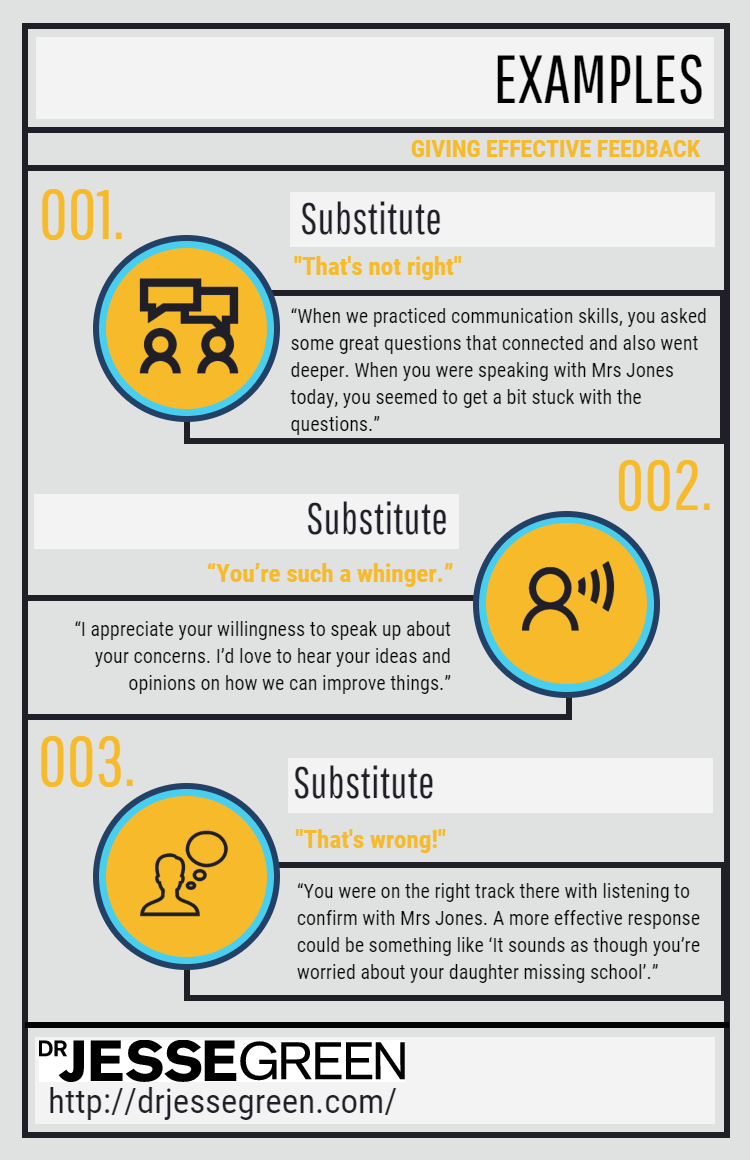
Here are a few examples.

Neg feedback

Of course, these guidelines are also useful when you’re giving positive feedback. Here are a few ideas.

Pos feedback

Stop Burying Your Head in The Sand

Ignore poor performance at your peril. It won’t go disappear. Instead it will nag at you like a festering sore.

Don’t let that happen.

Instead, make a time to talk to the person who’s causing concern. Treat them gently and with respect. Dig deep to find out what’s going on.

When you focus on the behaviour and the impact of their actions rather than focusing on the person, you’ll find the conversation is more productive.

Yes, it takes courage. Yes, it take patience. Yes, it can be uncomfortable.

But guess what?

These conversations can be the most constructive, important and valuable conversations you may ever have.

As Winston Churchill said:

“Courage is what it takes to stand up and speak; courage is also what it takes to sit down and listen.”

So pluck up your courage and speak. But don’t forget to listen too.